
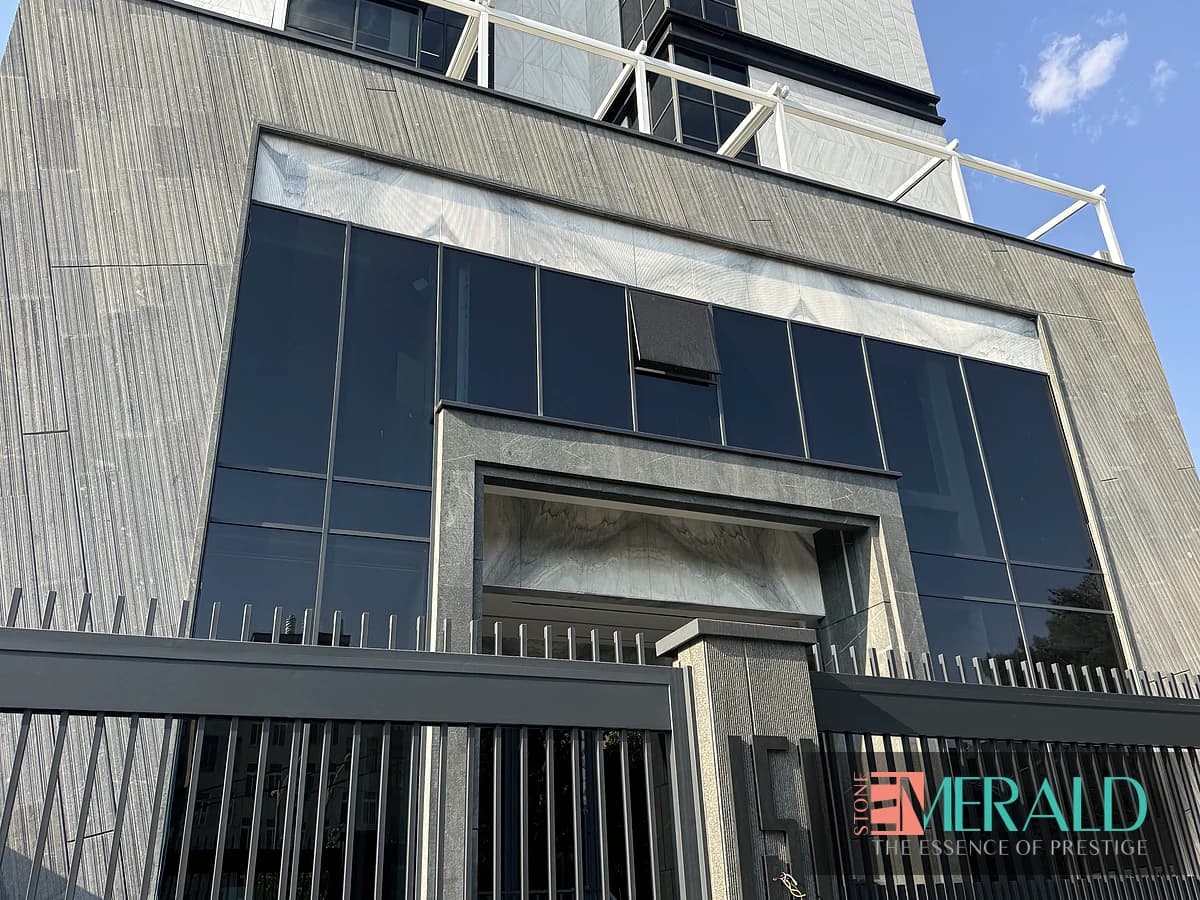
Building facade stone selection turns on four variables: water absorption, fixing system, slab thickness and surface finish. Travertine, at 1–3% absorption, is Iran's most specified cladding, while granite at 0.1–0.3% is the most durable. Two to three centimetres is standard thickness, and stone itself usually accounts for 40–50% of total facade cost.
Technical criteria for facade stone selection
Facade stone faces rain, UV exposure, temperature swings, and — at height — significant wind load. Water absorption, freeze-thaw resistance, slab thickness, specific weight, and structural uniformity are core engineering parameters. A stone ideal for interior flooring may fail on an exterior envelope due to moisture cycling.
Fixing system choice must be defined early. Mortar-bonded cladding, ventilated rainscreens, and hybrid assemblies each impose different thickness limits, finish requirements, and joint details. At Emerald Stone, facade drawings and structural specs are reviewed before any stone is recommended.
Surface finish affects long-term performance. Polished facades can increase rain runoff streaking and show stains; honed, bush-hammered, or sandblasted finishes suit exteriors better. In high-traffic or street-facing zones, abrasion resistance and periodic cleaning must weigh alongside aesthetics.
A common mistake is choosing stone from a small sample or catalog image alone. Samples should be evaluated at project scale, alongside other facade materials, and in the building's natural daylight. Emerald Stone offers slab viewing and technical consultation for architects and developers. Stone facades face daily moisture cycling; lower-absorption stone with matte finish delivers more stable performance against rain, freeze-thaw, and urban pollution. Install slabs following an approved layout drawing so joints do not fall across main circulation axes or primary sightlines in the space. On phased projects, keep a reference batch in stock so later phases match quarry, grade, and finish — large facades and lobbies look professionally uniform when batches are planned.
- Low water absorption is essential for rainy and cold-climate facade specifications
- Two to three centimetre thickness is standard for most residential and commercial envelopes
- Expansion joints and horizontal drip details are critical waterproofing points on stone facades
- Consistent color sorting matters visually and logistically on large-scale cladding projects
Facade styles: classic, Roman, and modern
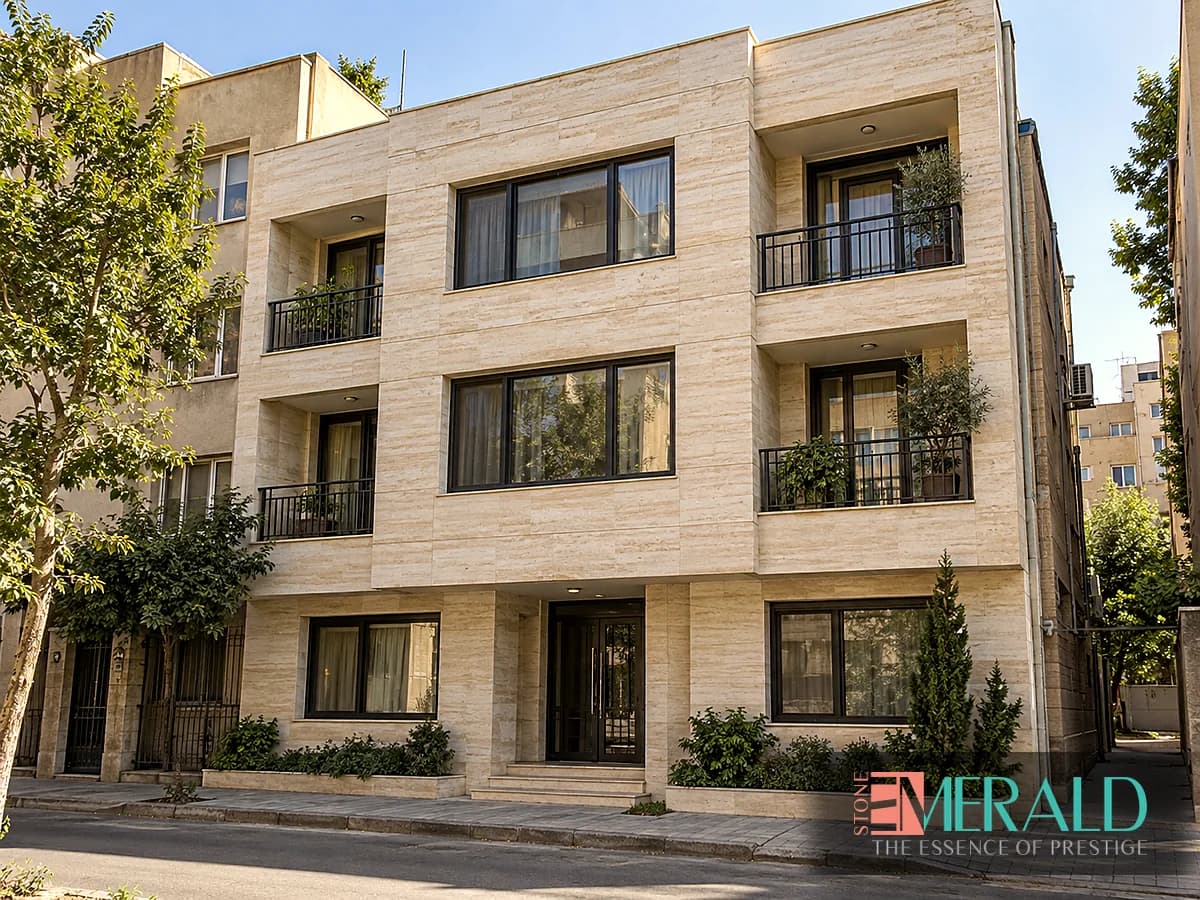
Classic and Roman facades feature stone mouldings, cornices, pilasters, and decorative tooling. Cream and white travertine with chiseled or tumbled finishes dominate this style. Travertine's moderate weight supports moulding work at a more controlled labour cost than very hard stones.
Modern facades emphasize large-format slabs, minimal joints, and stone combined with glass, metal, and timber. Silver travertine, black granite, and light marble suit urban towers and commercial buildings. Here, concealed fixing precision and plane alignment often outweigh decorative stone texture.
Hybrid facades combine multiple stone types or natural stone with composite panels. This controls budget and adds visual variety but demands tight coordination of color, thickness, and fixing methods across materials. Our Roman and modern facade clusters cover each style in depth.
Style choice should align with neighbourhood character, municipal codes, and building use. Luxury residences, office towers, and coastal villas each prioritize different stone and detailing decisions. Expansion joints, horizontal drip details, and window perimeter sealing are the three zones where most stone facade failures begin — detail them fully on execution drawings. After installation, choose sealers matched to climate and traffic; exterior and high-traffic zones need documented maintenance cycles from handover day onward. Stone facades face daily moisture cycling; lower-absorption stone with matte finish delivers more stable performance against rain, freeze-thaw, and urban pollution. Install slabs following an approved layout drawing so joints do not fall across main circulation axes or primary sightlines in the space.
- Low water absorption on facade stone prevents freeze-thaw damage and joint moisture ingress
- Wind load calculation before thickness selection is mandatory on tall facade envelopes
- Slab viewing in project daylight prevents costly colour mis-specification on site
- Documenting batch technical specs in the supply contract reduces delivery disputes
Comparing travertine, marble, and granite for facades
Travertine is Iran's most specified facade stone. Balanced weight, warm tones, tooling flexibility, and ventilated-system compatibility are key advantages. Higher water absorption than granite makes grade selection and professional sealing essential. See our travertine guide and travertine facade cluster for detail.
Granite is the hardest, least absorbent common facade option. It excels in cold, coastal, and high-durability projects. Higher weight and cutting/freight cost are trade-offs. Our granite guide covers Iranian varieties including Natanz.
Marble suits luxury facades with uniform texture and natural polish. Outdoor use demands more care — water absorption and sensitivity to environmental acids influence finish and joint design. Our marble guide covers quarries and grading.
No single stone is universally 'best'; final choice depends on climate, building height, fixing system, and budget. Our best facade stones cluster ranks options by project conditions. Travertine balances aesthetics, weight, and workability for most Iranian residential and commercial facades; our travertine guide is the complementary reference. Align architect, supervising engineer, stone contractor, and supplier before final order to avoid mid-project stoppages and emergency batch replacements. Expansion joints, horizontal drip details, and window perimeter sealing are the three zones where most stone facade failures begin — detail them fully on execution drawings. After installation, choose sealers matched to climate and traffic; exterior and high-traffic zones need documented maintenance cycles from handover day onward.
- Expansion joints every 6–8 metres prevent thermal movement cracking on stone facades
- Window perimeter and head sealing are the most common water ingress points on stone cladding
- Honed or sandblasted finishes outperform polished surfaces on exterior facade zones
- Supplier and installer coordination ensures fixing quality and long-term facade durability
Municipal codes, safety, and fire performance
In many Iranian cities, facade codes restrict color, material type, fire performance, and — at height — structural requirements. Municipal inquiry or zoning review before finalizing stone is recommended.
On tall buildings, wind and seismic loads directly affect anchor design and stone thickness. Structural calculations must be signed off by the supervising engineer. Poor installation risks delamination even with premium stone.
Stone itself is typically fire-resistant, but fixing systems, insulation behind cladding, and overall envelope layers affect composite behaviour. Coordination between architect, structural engineer, and stone supplier is mandatory on commercial projects.
In historic districts, specific stones or traditional finishes may be required. Emerald Stone proposes options compatible with local rules and technical standards on sensitive projects. Granite is the safer choice in cold and coastal climates due to very low absorption and high hardness; our granite guide covers domestic varieties including Natanz. Batch test reports covering water absorption, compressive strength, and surface hardness clarify travertine, marble, and granite choices for each application zone. Travertine balances aesthetics, weight, and workability for most Iranian residential and commercial facades; our travertine guide is the complementary reference. Align architect, supervising engineer, stone contractor, and supplier before final order to avoid mid-project stoppages and emergency batch replacements.
- Low water absorption on facade stone prevents freeze-thaw damage and joint moisture ingress
- Wind load calculation before thickness selection is mandatory on tall facade envelopes
- Slab viewing in project daylight prevents costly colour mis-specification on site
- Documenting batch technical specs in the supply contract reduces delivery disputes
Approximate stone facade cost
Facade cost combines stone supply, installation, anchoring or mortar systems, freight, crane hire, and substrate preparation. Stone typically represents 40–50% of total cost; labour and subsystems account for the remainder — ratios vary by stone type and facade complexity.
Roman moulded facades, tall rainscreen systems, and difficult-access sites raise installation cost. First-grade stone with tight sorting may increase material cost but reduces future replacement expense.
Accurate estimates require facade area, corner and projection counts, stone type, and fixing system. Our facade pricing cluster explains per-square-metre ranges and cost drivers.
Emerald Stone quotes stone supply separately and offers execution advisory. Clients can compare several stone options with budget estimates before final decisions. Before final order, review stone samples on site alongside other facade or floor finishes; daylight angle and temperature shift color and texture noticeably, preventing costly specification mistakes. At Emerald Stone, stone selection follows application analysis; we balance aesthetics, durability, and total cost of ownership — not unit price alone. Granite is the safer choice in cold and coastal climates due to very low absorption and high hardness; our granite guide covers domestic varieties including Natanz.
- Expansion joints every 6–8 metres prevent thermal movement cracking on stone facades
- Window perimeter and head sealing are the most common water ingress points on stone cladding
- Honed or sandblasted finishes outperform polished surfaces on exterior facade zones
- Supplier and installer coordination ensures fixing quality and long-term facade durability
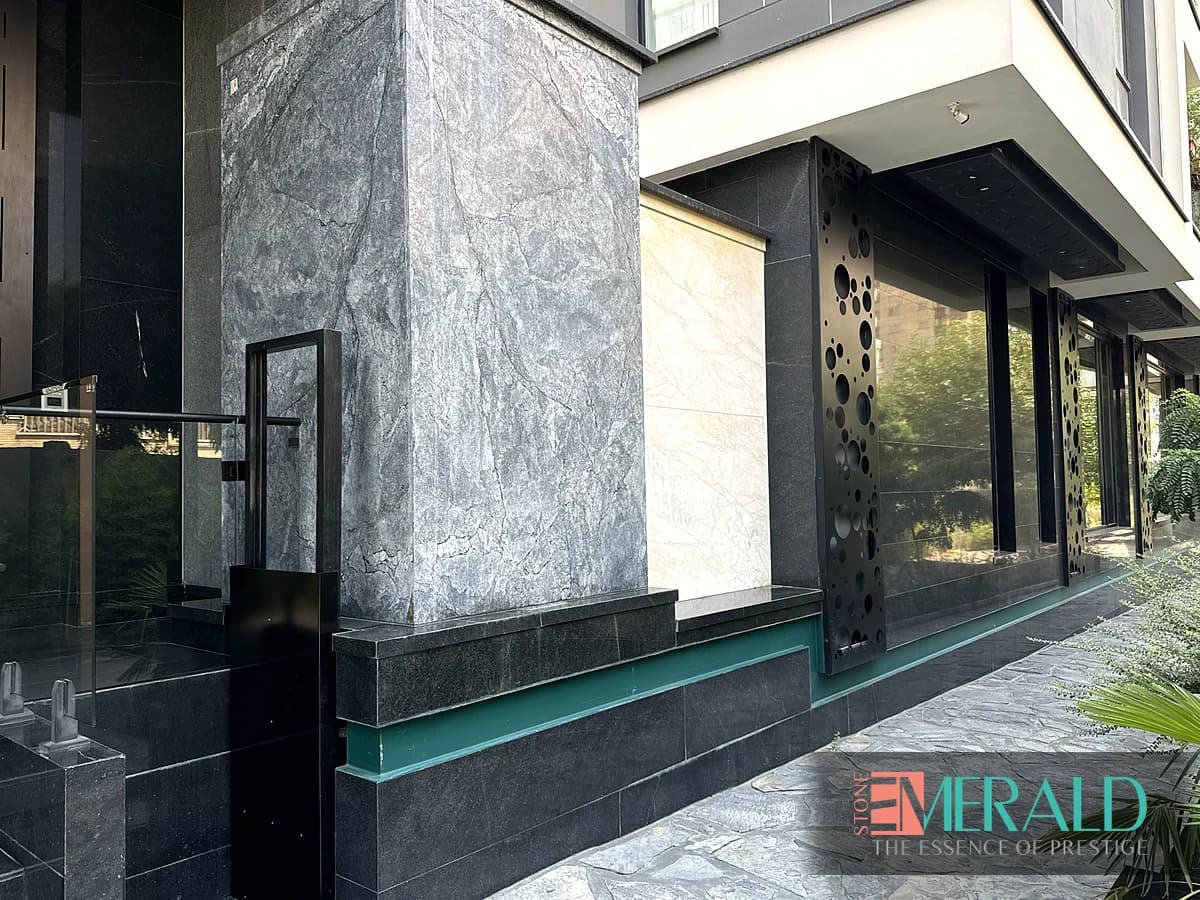
Engineered facade stone selection process
Emerald Stone's standard process starts with application analysis: building type, climate, height, architectural style, and budget. Two to three stone options with technical specs and price bands follow.
Next comes sampling and, where possible, warehouse slab viewing. Stone color in project daylight differs from warehouse lighting — site viewing prevents costly mistakes.
After approval, supply scheduling, sorting, cutting, and execution coordination are planned. Facade drawings with thickness, finish, and joint details go to the contractor.
Delivery quality checks against approved samples are integral to engineered supply. The goal is eliminating mid-project color or grade mismatch. Define numeric tolerances for fissures, pits, tone variation, and batch uniformity in the supply contract so delivery disputes drop and installation schedules stay on track. On tall facades, wind load calculations and mechanical fixing design should precede final stone thickness selection so envelope safety is assured for the building's service life. Before final order, review stone samples on site alongside other facade or floor finishes; daylight angle and temperature shift color and texture noticeably, preventing costly specification mistakes.
- Low water absorption on facade stone prevents freeze-thaw damage and joint moisture ingress
- Wind load calculation before thickness selection is mandatory on tall facade envelopes
- Slab viewing in project daylight prevents costly colour mis-specification on site
- Documenting batch technical specs in the supply contract reduces delivery disputes
Facade stone fixing systems
Mortar installation is the traditional, economical method for low-rise buildings. Stone bonds to the wall with cement mortar or specialist adhesive. Controlling stone absorption and substrate prep is critical.
Ventilated rainscreens with mechanical anchors and an air gap suit towers and tall buildings. Rear cavity moisture management and thermal performance improve. Our facade installation cluster covers technical detail.
System choice affects structure, stone thickness, and maintenance. Mid-project system changes are expensive and should be finalized at design stage.
In both methods, jointing, horizontal drips, and window perimeter sealing are where most facade failures begin. Supplier–contractor coordination determines final quality. Slab thickness must align with substrate design, fixing system, wind load, or traffic level; extra thickness without structural planning only raises cutting, freight, and anchor cost without real durability gain. On interior floors, document underfloor heating compatibility and thermal expansion joints in execution drawings so seasonal heat cycles do not cause cracking or lippage. Define numeric tolerances for fissures, pits, tone variation, and batch uniformity in the supply contract so delivery disputes drop and installation schedules stay on track.
- Expansion joints every 6–8 metres prevent thermal movement cracking on stone facades
- Window perimeter and head sealing are the most common water ingress points on stone cladding
- Honed or sandblasted finishes outperform polished surfaces on exterior facade zones
- Supplier and installer coordination ensures fixing quality and long-term facade durability
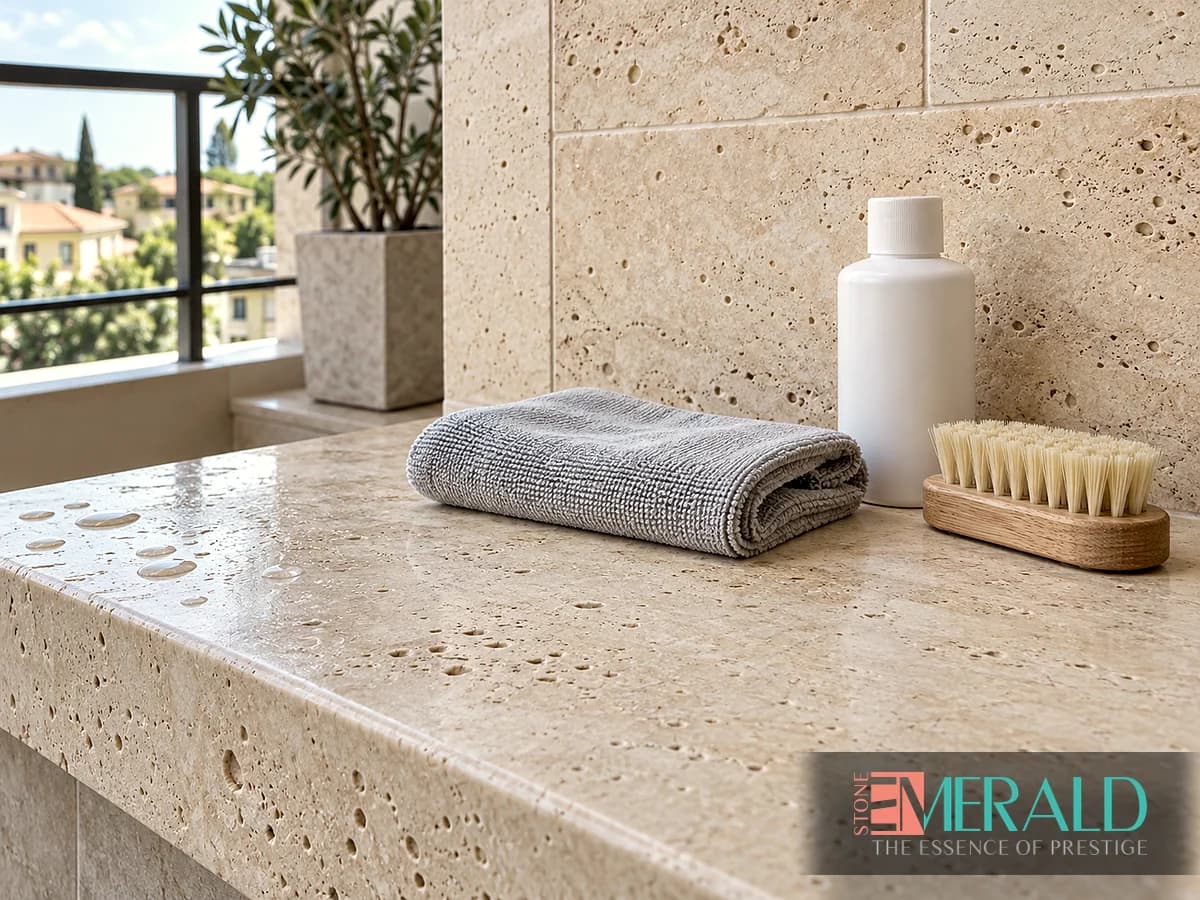
Emerald Stone approach to facade projects
Emerald Stone positions itself as an engineering partner on facade projects — not merely a stone vendor. Our team coordinates with architects, clients, and contractors to supply suitable stone with minimal execution risk.
Experience on projects such as the public space facade and Farvardin Tower shows that correct stone choice and uniform sorting define large-scale visual impact. Kashmar cream travertine and crystal silver are among our most requested modern facade products.
Services include free technical consultation, comparative stone options, bulk supply, shipment quality control, and execution coordination. Start via the specialist guides below or our contact form. On phased projects, keep a reference batch in stock so later phases match quarry, grade, and finish — large facades and lobbies look professionally uniform when batches are planned. Consistent color sorting matters as much as technical grade on large projects; unplanned multi-batch delivery without a layout strategy looks unprofessional at completion. Slab thickness must align with substrate design, fixing system, wind load, or traffic level; extra thickness without structural planning only raises cutting, freight, and anchor cost without real durability gain.
- Low water absorption on facade stone prevents freeze-thaw damage and joint moisture ingress
- Wind load calculation before thickness selection is mandatory on tall facade envelopes
- Slab viewing in project daylight prevents costly colour mis-specification on site
- Documenting batch technical specs in the supply contract reduces delivery disputes
| Stone type | Water absorption | Weight | Common style | Emerald recommendation |
|---|---|---|---|---|
| Travertine | Medium (1–3%) | Medium | Classic and modern | Most residential and commercial facades |
| Granite | Low (0.1–0.3%) | High | Modern and industrial | Harsh climates and tall buildings |
| Marble | Low to medium | Medium | Luxury | Facades with professional sealing |
| Hybrid | Variable | Variable | Modern | Budget control and visual variety |
Related products
Related projects
Frequently asked questions
What is the best stone for building facades?
For most residential and commercial projects in Iran, first-grade travertine with proper sealing offers the best balance of aesthetics, cost, and installability. In very cold or coastal climates, low-absorption granite performs better. Final choice should match climate, fixing system, and project budget.
What does stone facade cladding cost per square metre?
Facade cost depends on stone type, grade, fixing system, building height, and moulding complexity. Stone typically represents 40–50% of total cost; installation and subsystems account for the rest. Contact Emerald Stone for a project-specific estimate. For a precise decision, visit slabs on site and request the batch technical report.
Is marble suitable for exterior facades?
Yes, with appropriate grade, honed or matte finish, and professional jointing. Marble absorbs less water than travertine but is more sensitive to environmental acids. In industrial or high-pollution zones, granite or sealed travertine may be more practical. For a precise decision, visit slabs on site and request the batch technical report.
What is the difference between rainscreen and mortar facades?
Mortar-bonded cladding attaches stone directly to the wall — economical for low-rise buildings. Ventilated rainscreens use mechanical anchors and an air gap — safer for towers and better at managing moisture. System choice must be coordinated with the structural engineer at design stage.
What thickness is standard for facade stone?
Two to three centimetres suits most residential and commercial facades. Taller rainscreen projects may require three centimetres or more. Thickness must align with anchor design and wind load. For a precise decision, visit slabs on site and request the batch technical report.
What does Emerald Stone provide for facade projects?
Free technical consultation, two to three comparative stone options, bulk supply with controlled sorting, slab viewing, and execution coordination. Reference projects include the public space facade and Farvardin Tower. For a precise decision, visit slabs on site and request the batch technical report.
Free stone engineering consultation
Emerald Stone's engineering team helps you select the right stone for your project scope, budget, and execution details.
Request free consultation