
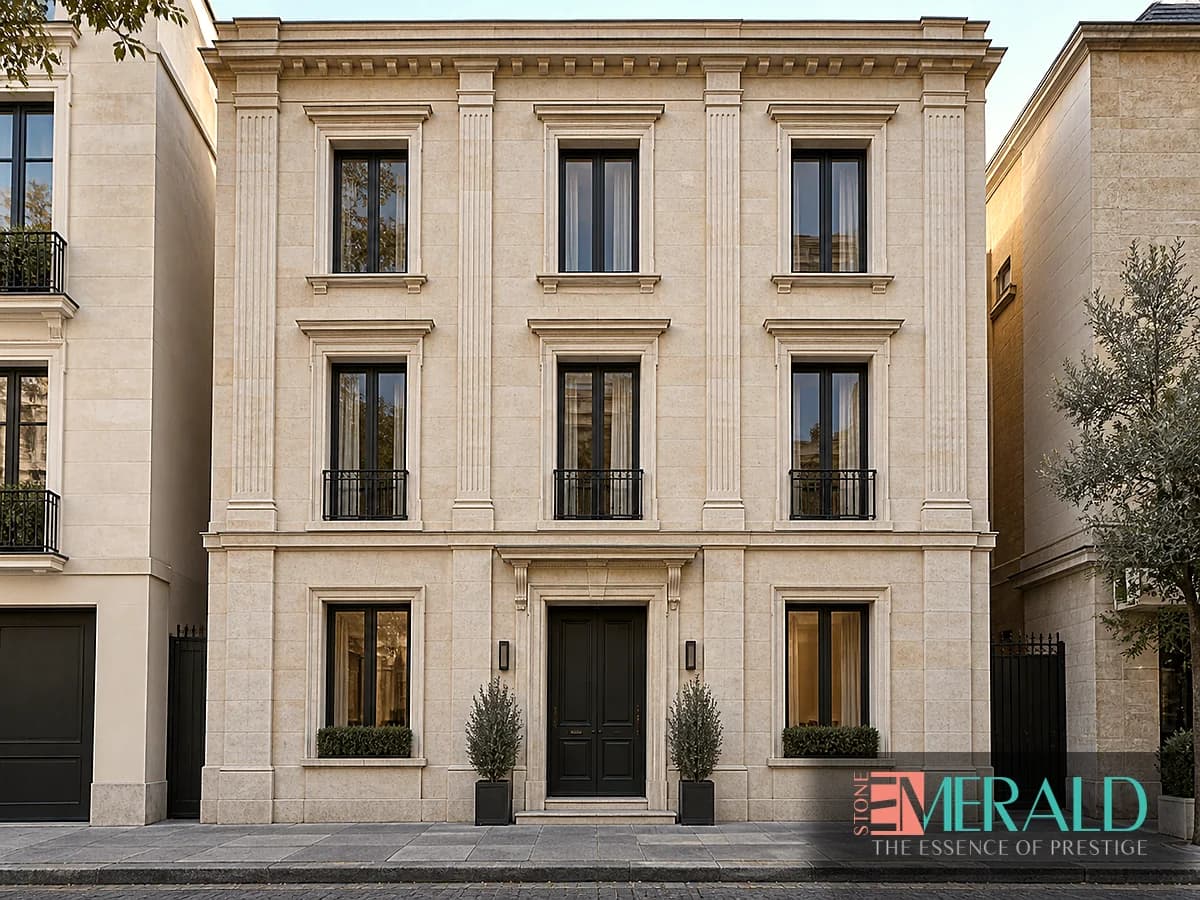
Roman facades are built on symmetry, colonnades, cornices, arches and horizontal banding, with decorative mouldings cut by hand or CNC. Kashmar cream and Hajiabad white travertine in chiseled or tumbled finishes are the standard materials; cream marble suits feature zones. Cost runs 20–40% higher than modern cladding of the same area.
Related guide: Building facade stone guide
Roman facade elements and stone mouldings
Roman facades are built on symmetry, colonnades, cornices, arches, and horizontal banding. Stone mouldings are decorative cuts — hand or CNC executed — that add depth and shadow to the envelope.
In Iranian projects, travertine is the primary Roman facade material due to workability and balanced weight. Cream marble suits luxury zones; granite sometimes appears at bases and high-traffic areas.
Roman design must align precisely with architectural drawings. Every moulding piece — cornice to frieze — has defined dimensions, thickness, and finish. One wrong detail can disrupt the entire facade alignment.
For stone comparison, Emerald Stone's travertine and marble guides are reference resources for moulding and cladding selection. Stone facades face daily moisture cycling; lower-absorption stone with matte finish delivers more stable performance against rain, freeze-thaw, and urban pollution. Before final order, review stone samples on site alongside other facade or floor finishes; daylight angle and temperature shift color and texture noticeably, preventing costly specification mistakes.
- Horizontal cornices at floor transitions are signature Roman facade elements
- Column mouldings demand high precision in cutting and installing multiple pieces
- Chiseled and tumbled finishes create the aged, authentic classical appearance
- Color consistency across all moulding pieces is visually critical on large facades
Best stone for Roman facades
Kashmar cream and Hajiabad white travertine are Iran's most requested Roman facade stones. Warm tones and natural texture suit classical architecture and support moulding work.
Chiseled finish creates semi-relief surfaces ideal for cornices and friezes. Tumbled finish rounds edges and ages the surface for authentic character.
On tighter budgets, mouldings can use first-grade travertine while flat areas use second grade — provided color difference stays acceptable.
Emerald Stone supplies Kashmar cream travertine with uniform sorting for Roman projects and coordinates slab dimensions with architects at design stage. Expansion joints, horizontal drip details, and window perimeter sealing are the three zones where most stone facade failures begin — detail them fully on execution drawings. Define numeric tolerances for fissures, pits, tone variation, and batch uniformity in the supply contract so delivery disputes drop and installation schedules stay on track.
- Low water absorption on facade stone prevents freeze-thaw damage and joint moisture ingress
- Wind load calculation before thickness selection is mandatory on tall facade envelopes
- Slab viewing in project daylight prevents costly colour mis-specification on site
- Documenting batch technical specs in the supply contract reduces delivery disputes
Moulding execution and quality control
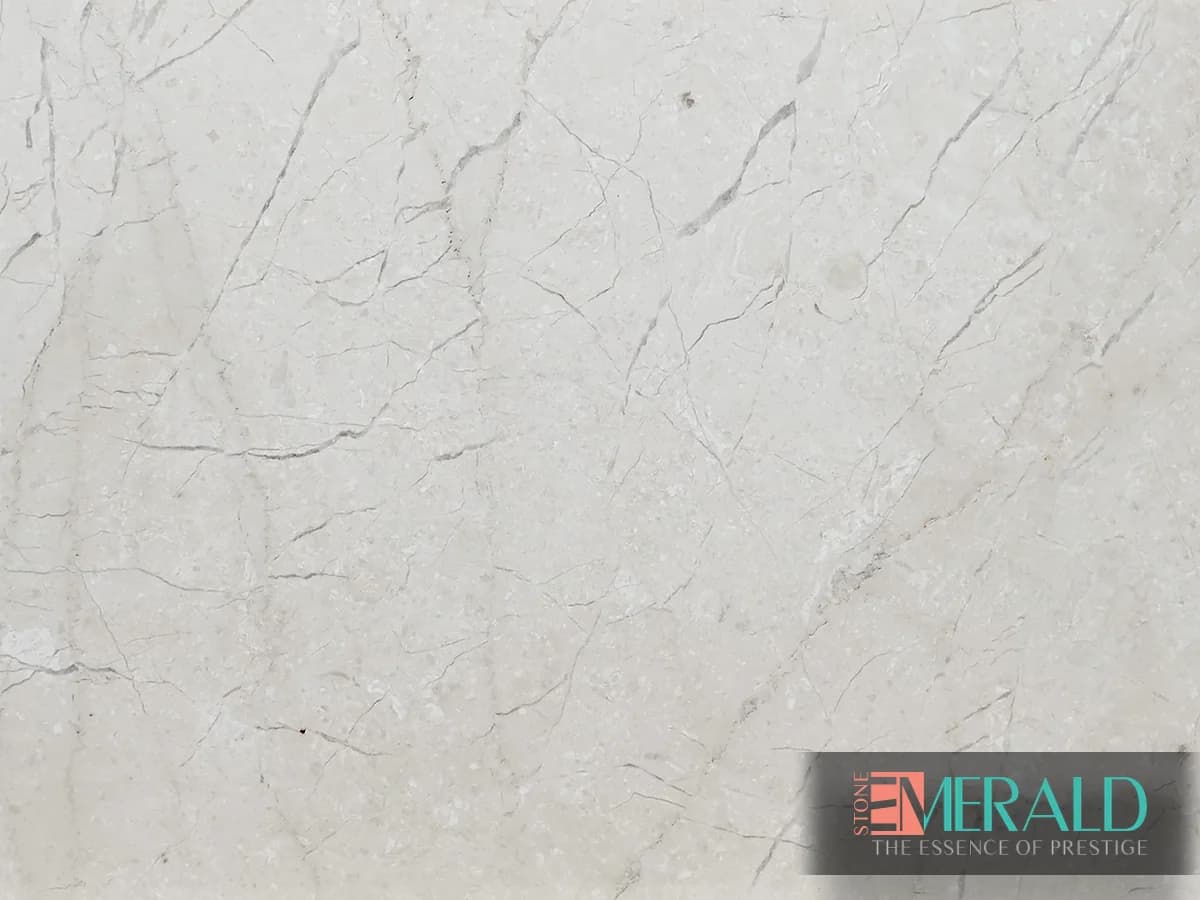
Roman facade installation is more time-consuming and specialist than modern cladding. Each moulding piece must be cut, finished, and installed to drawing with precise spacing and alignment. CNC-equipped workshops improve accuracy and speed.
Specialist facade mortar, jointing, and window perimeter sealing remain critical. Relief mouldings can trap water in grooves — slope and expansion joint design must be exact.
Emerald Stone supplies stone and coordinates with reputable moulding workshops. The public space facade project exemplifies natural stone with architectural detailing.
Site quality control covers alignment, color, and moulding integrity before final pointing. Periodic supervising engineer visits are recommended. Travertine balances aesthetics, weight, and workability for most Iranian residential and commercial facades; our travertine guide is the complementary reference.
- Expansion joints every 6–8 metres prevent thermal movement cracking on stone facades
- Window perimeter and head sealing are the most common water ingress points on stone cladding
- Honed or sandblasted finishes outperform polished surfaces on exterior facade zones
- Supplier and installer coordination ensures fixing quality and long-term facade durability
Roman facade cost versus modern cladding
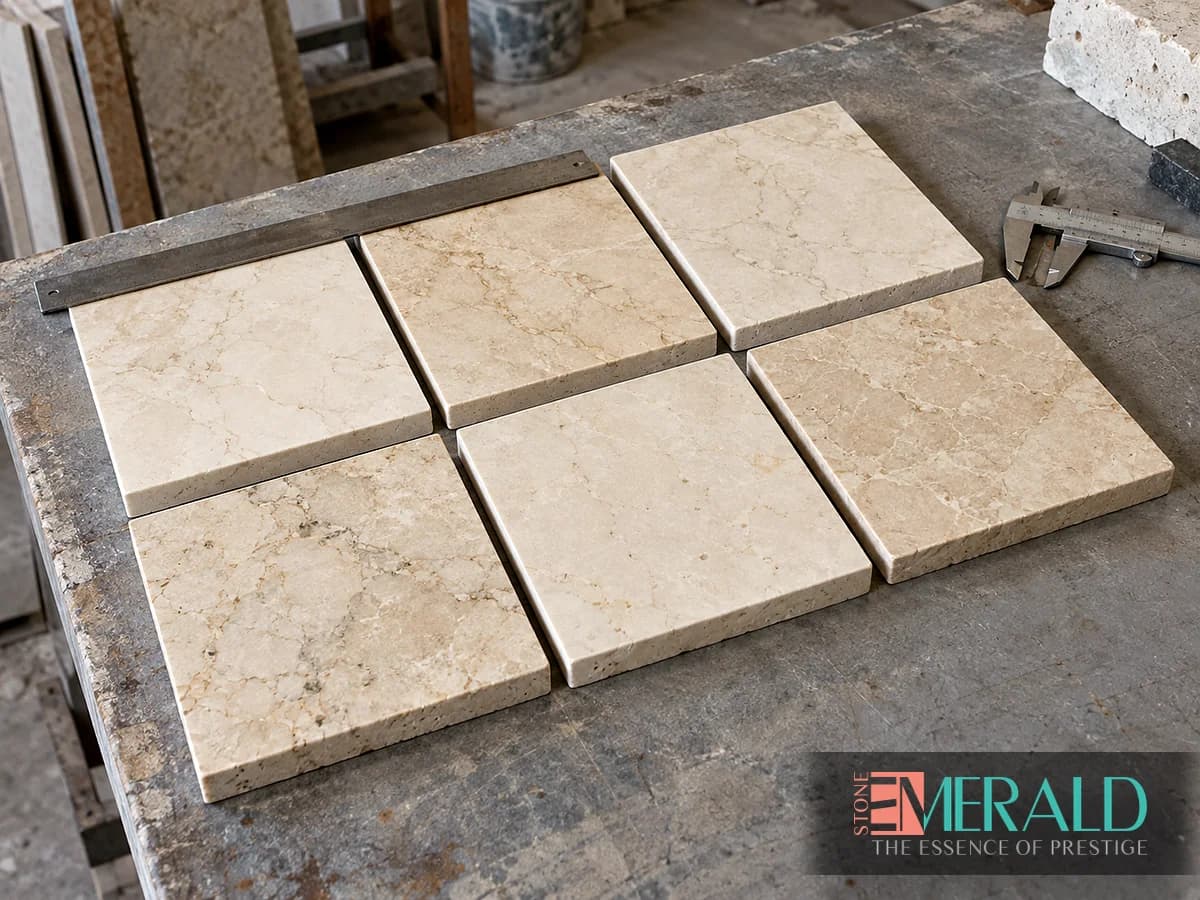
Roman facades typically cost 20–40% more than modern cladding of the same area — mainly due to moulding labour and longer installation time. Stone price may be similar but moulding cutting waste is higher.
To control cost, mouldings can be limited to ground floor and street-facing elevations while upper floors use simpler treatment — common on luxury residential buildings.
Our facade cost cluster breaks down stone, labour, and moulding expenses. Contact Emerald Stone for a Roman facade project estimate.
Stone facades face daily moisture cycling; lower-absorption stone with matte finish delivers more stable performance against rain, freeze-thaw, and urban pollution. Granite is the safer choice in cold and coastal climates due to very low absorption and high hardness; our granite guide covers domestic varieties including Natanz.
- Low water absorption on facade stone prevents freeze-thaw damage and joint moisture ingress
- Wind load calculation before thickness selection is mandatory on tall facade envelopes
- Slab viewing in project daylight prevents costly colour mis-specification on site
- Documenting batch technical specs in the supply contract reduces delivery disputes
Emerald Stone approach to Roman facades
On Roman facade projects, Emerald Stone supports clients and architects from stone selection through delivery with uniform sorting. Kashmar cream travertine is a top product in this category.
Reference work including the public space facade and Farvardin Tower demonstrates our large-scale experience. Request free stone engineering consultation for Roman facade stone selection.
Expansion joints, horizontal drip details, and window perimeter sealing are the three zones where most stone facade failures begin — detail them fully on execution drawings.
Travertine balances aesthetics, weight, and workability for most Iranian residential and commercial facades; our travertine guide is the complementary reference.
Granite is the safer choice in cold and coastal climates due to very low absorption and high hardness; our granite guide covers domestic varieties including Natanz.
Before final order, review stone samples on site alongside other facade or floor finishes; daylight angle and temperature shift color and texture noticeably, preventing costly specification mistakes.
- Expansion joints every 6–8 metres prevent thermal movement cracking on stone facades
- Window perimeter and head sealing are the most common water ingress points on stone cladding
- Honed or sandblasted finishes outperform polished surfaces on exterior facade zones
- Supplier and installer coordination ensures fixing quality and long-term facade durability
| Stone | Finish | Application | Advantage |
|---|---|---|---|
| Cream travertine | Chiseled/tumbled | Classic facade | Moulding workability and warm tone |
| White travertine | Chiseled | Light facade | Luxury uniform appearance |
| Cream marble | Honed | Feature zones | Fine texture and natural polish |
| Granite | Sandblasted | Base and entry | High traffic durability |
Related products
Related projects
Frequently asked questions
What is the best stone for Roman facades?
Cream and white travertine with chiseled or tumbled finishes dominate Roman facades in Iran. Balanced weight and tooling workability suit cornices, friezes, and pilasters. Cream marble suits luxury zones; granite sometimes serves bases and high-traffic entries. Final choice must align with architectural drawings and project budget.
What is the difference between chiseled and tumbled finishes on Roman facades?
Chiseled finish creates a semi-relief irregular texture suited to cornices and horizontal bands. Tumbled finish rounds edges and ages the surface for a more authentic classical look. Both demand precise workshop cutting and quality control. Emerald Stone can supply samples of each finish for architect approval.
How much more does a Roman facade cost than a modern one?
Roman facades typically cost 20–40% more than modern cladding at the same area. Most of the difference comes from moulding labour, longer installation time, and higher cutting waste. Stone unit cost may be similar but piece count and fixing precision increase. Tooling only at ground floor controls budget.
Is marble suitable for Roman facades?
Yes — cream marble suits feature zones such as main entrances or central decoration. Fine texture and natural polish create a luxury appearance at higher cutting and maintenance cost. Outdoors, matte finish and professional jointing are essential. Combining marble with travertine on one facade is a common approach.
What does Emerald Stone provide for Roman facade projects?
Emerald Stone supplies Kashmar cream travertine with uniform sorting for Roman facades and coordinates slab dimensions with architects at design stage. Free technical consultation, slab viewing, and coordination with moulding workshops are included. The public space facade project demonstrates our experience on architecturally detailed envelopes.
Free stone engineering consultation
Emerald Stone's engineering team helps you select the right stone for your project scope, budget, and execution details.
Request free consultation