
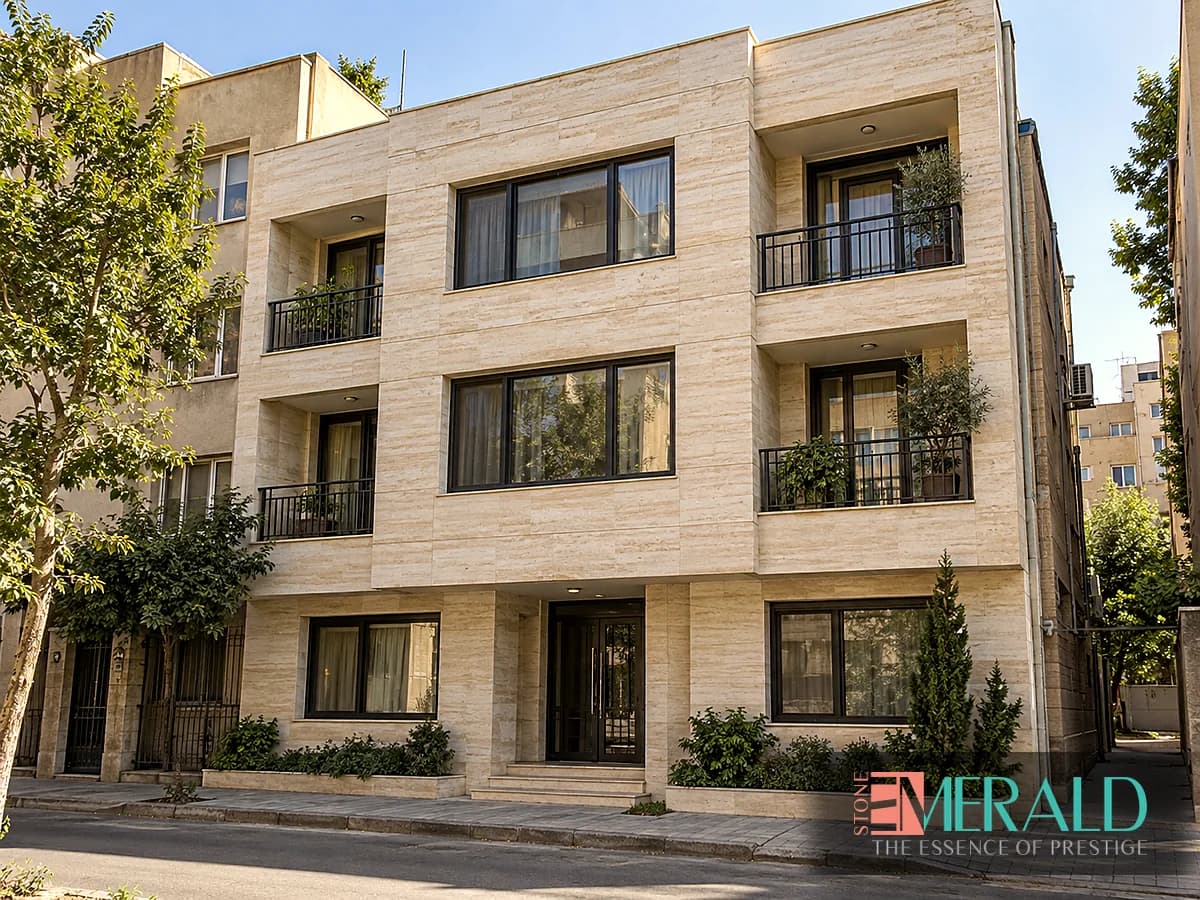
Travertine is a porous sedimentary limestone deposited by calcium-carbonate-rich hot springs, quarried in Iran at Hajiabad, Kashmar, Abbasabad and Atashkooh. Water absorption runs one to three percent and compressive strength is medium, so facades typically use 2 to 3 cm slabs, with quarry, grade and cut direction chosen against application, climate and budget.
What is travertine and why architects specify it
Travertine describes a family of sedimentary limestones formed by mineral-rich hot springs depositing calcium carbonate over thousands of years. Natural porosity, layered texture, and warm cream-to-ivory tones make it one of the most popular choices for classic and contemporary architecture in Iran.
In construction, travertine offers favorable weight versus granite, strong tooling options, and compatibility with ventilated facade systems across residential, commercial, and villa projects. Higher water absorption than igneous stones means grade, finish, and sealing must match the real application.
Travertine's popularity in Iranian luxury architecture comes from its visual warmth, reasonable installed cost versus some harder stones, and finish diversity from vein-cut to tumbled antique textures. Alongside marble, it forms one of the two pillars of the country's building stone industry.
Industrially, travertine sits in the porous calcareous stone category and is assessed through standardized water absorption, compressive strength, and surface quality tests. Technical lot reports for sensitive projects form the basis of Emerald Stone's engineering consultation.
On export and international tower projects, Iranian travertine holds a strong position thanks to color diversity and competitive pricing. Overseas buyers should align technical reports, grade, and sorting plans exactly with approved samples to avoid delivery disputes.
Iranian travertine is also widely used in hotel lobbies, retail facades, public buildings, and civic projects where warm natural stone texture must read well under both daylight and artificial lighting. Sample panels installed on site before bulk order remain the most reliable specification method.
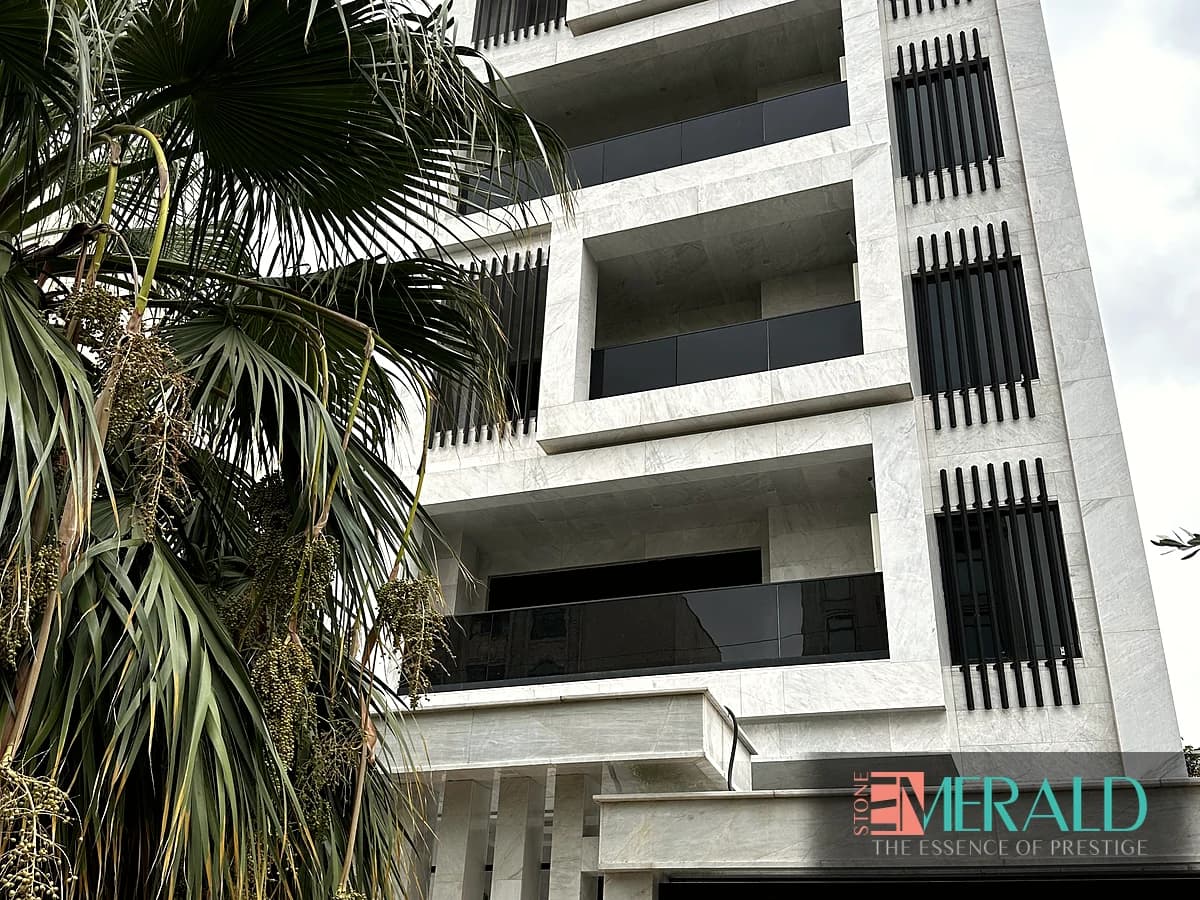
Vein-cut, cross-cut, chiseled, and tumbled finishes
Vein-cut travertine follows the stone's natural bedding direction, creating linear vertical movement popular on modern facades, interior feature walls, and premium lobbies. This cut adds depth and directional rhythm to wall surfaces.
Cross-cut travertine yields a cloudier, more uniform pattern suited to large hall floors, open interiors, and projects where color consistency matters more than dramatic veining. Many large envelopes combine vein-cut and cross-cut across different building zones.
Chiseled finishes create a semi-relief handcrafted surface ideal for Roman-style facades, classic villas, and traditional architecture. Tumbled antique finishes round the edges and age the surface for landscape walls and garden features.
Emerald Stone recommends cut direction, slab thickness, and final finish based on wind load, anchoring system, joint design, and maintenance expectations. Wrong cut selection on a tower facade can create visual inconsistency between floors or increase cutting waste.
For lobbies and interior zones, honed or polished light travertine creates a premium effect, while flame-finished or tumbled surfaces improve safety and durability on exterior stairs and landscape paving.
Bush-hammered vein-cut travertine is increasingly specified on contemporary facades where architects want texture without the heavy relief of chiseled finishes. This finish also hides minor surface weathering better than polished travertine on rain-exposed zones.
- Vein-cut: linear vertical texture — modern facades and lobby walls
- Cross-cut: more uniform cloud pattern — large floors and open halls
- Chiseled: semi-relief handcrafted surface — classic facades and villas
- Tumbled antique: rounded edges and aged surface — landscape and garden walls
- Honed and polished: smooth surfaces for lobbies and premium interiors
Major Iranian travertine quarries
Hajiabad in Markazi province is one of Iran's best-known sources of white to light-cream travertine. Hajiabad stone, valued for higher whiteness and relatively uniform texture, is most requested on luxury facades, residential tower lobbies, and light-themed projects.
Kashmar in Razavi Khorasan supplies uniform warm cream travertine. Kashmar cream travertine, prized for color consistency across large production lots, is a signature Emerald Stone product for residential towers, northern villas, and modern cream-themed commercial projects.
Abbasabad, Atashkooh, Darehbakhari, and regions around Isfahan also produce warm cream-to-beige travertine that often serves as more economical options for large envelopes with controlled budgets. Crystal silver from select quarries supports grey modern palettes on urban towers.
Each quarry differs in color range, pore density, and compressive strength due to local geology, so no single quarry can be labeled the absolute 'best' — selection should follow project application, climate, budget, and architectural style. Emerald Stone recommends a quarry combination matched to these factors for every project.
Export demand for Iranian travertine has grown in recent years, with quarries such as Hajiabad and Kashmar supplying projects across the Gulf region and neighboring countries. This growth has raised the importance of consistent quality control and standardized technical reporting for Iranian suppliers.
For coastal villas in humid northern regions, quarry selection must account for high moisture and airborne salt. Travertine with controlled porosity and periodic sealing delivers more stable performance than generic market grades in these climates.
Quarry lead times vary seasonally: winter extraction slowdowns and export demand peaks can affect delivery schedules on large facade orders. Emerald Stone plans quarry orders and warehouse staging ahead of peak construction seasons to protect project timelines.
Technical specifications of travertine stone
Travertine water absorption typically ranges between one and three percent, placing it in the relatively absorbent stone category. This characteristic highlights the need for appropriate grade, resin treatment, and professional sealing in wet zones and rain-exposed facades.
Compressive strength sits in the medium range, delivering adequate performance for facades, interior walls, and low-traffic floors. In busy commercial corridors, first-grade travertine with resin or granite in main traffic paths is often recommended.
Common slab thickness runs 2–3 cm for facades, 2 cm for interior floors, and 2–4 cm for landscape use. On tall buildings, dead-load calculation and appropriate anchoring system selection are mandatory technical steps before purchase.
The table below offers an approximate comparison of travertine against marble and granite across water absorption, compressive strength, weight, and facade suitability. Architects should treat these figures as a starting point and confirm exact values with a lab report from the specific production lot being purchased.
Travertine unit weight typically falls around 2,400 to 2,600 kg per cubic meter. On tall ventilated facades, dead-load calculation and anchoring system approval by a structural engineer are mandatory before final specification.
Surface hardness is lower than granite, which makes chiseled and tumbled finishes easier to achieve but also means honed travertine floors need periodic re-sealing in high-traffic zones. Factory resin filling of natural pores is standard on export-grade first-quality slabs.
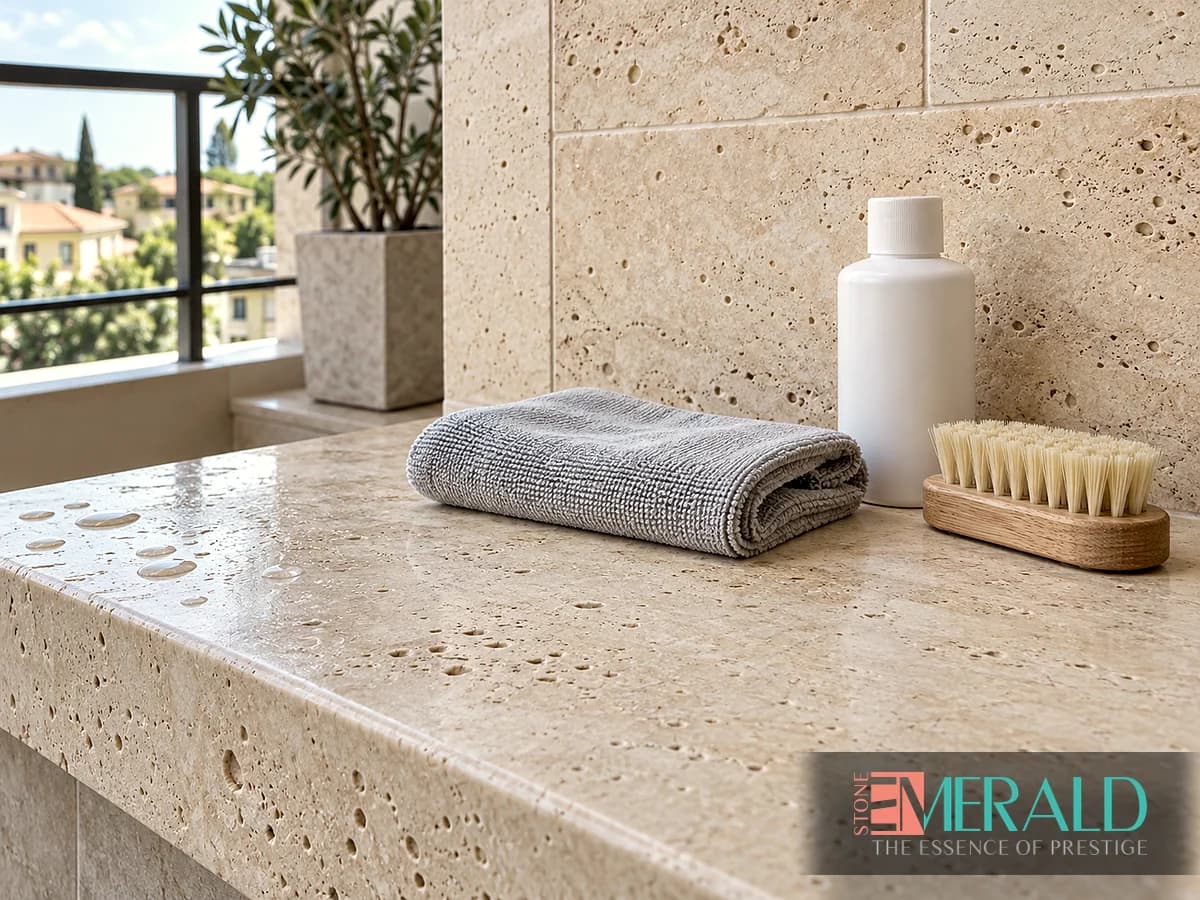
Travertine vs marble and granite
Travertine is more porous than marble but often performs better on exteriors against temperature cycling and freeze-thaw exposure. Marble delivers finer polish and visual elegance yet needs more caution on directly rain-exposed facades in humid climates.
Granite is harder, less absorbent, and more abrasion-resistant, but typically heavier and costlier to install. For heavy-traffic floors, demanding landscapes, and kitchen countertops, granite is the safer specification.
Final choice should follow real application: economical classic facades in travertine, premium lobbies in marble or light travertine, heavy-traffic floors in granite, and natural-textured outdoor zones in flame-finished or tumbled travertine. Our travertine vs marble cluster offers a deeper comparison.
Price comparison must happen at equal grade, thickness, and finish. Total cost of ownership includes stone, installation, sealing, and maintenance — not slab price per square meter alone. Decisions based on catalog photos without on-site viewing carry significant project risk.
In lobbies and interiors, marble delivers a brighter polish, while travertine adds warmer natural texture. Many architects on luxury projects specify travertine on the facade and marble on the lobby floor to balance cost and visual impact.
Climate matters as much as stone type: travertine performs well on dry facades with proper joint design, while marble needs more protection in high-rainfall regions. Architects in Tehran, Isfahan, and coastal northern cities should weigh these factors differently when specifying envelope stone.
Typical travertine applications
Building facades are travertine's most important application in Iran. On residential towers, cream or white travertine paired with glass and metal creates modern visual balance; on classic villas, chiseled or tumbled finishes deliver warm traditional character.
Interior lobby walls, feature walls, and low-traffic floors are other frequent uses. In lobbies and commercial spaces, light travertine with linear lighting creates a lasting premium effect.
Stairs, pool surrounds, landscape paving, and garden walls also suit travertine when grade, slope, and sealing are specified correctly. Outdoors, flame-finished or tumbled surfaces improve slip resistance.
Pool surrounds and spa areas demand lower-porosity grades with enhanced sealing because chlorine and mineral-rich water accelerate surface wear. Emerald Stone recommends specific maintenance cycles for these wet-zone applications during the specification phase.
For tower facades and large envelopes, coordination with shop drawings, waterproofing details, mortar selection, and expansion joints is critical. Emerald Stone aligns thickness, fixing method, and layout planning with architect and contractor from design through supply.
On mixed-material facades, travertine often pairs with glass, metal, and wood in contemporary architecture. Stone color should be coordinated with other material palettes from the design phase onward to avoid tonal or textural clash on site.
Engineering selection criteria
Final application, traffic level, lighting conditions, climate, and architectural style are the primary criteria for quarry and grade selection and must be defined precisely before ordering.
For facades, lower-porosity grades, 2–3 cm thickness, and resin treatment on exposed zones are recommended. For busy commercial floors, first-grade travertine with professional sealing or granite substitution on main paths should be evaluated.
Color consistency across slabs on large facades requires ordering from a single production lot with professional sorting. Otherwise color variation between floors becomes clearly visible in daylight.
On-site sampling under natural and artificial light before purchase is essential. Recording quarry, grade, thickness, and finish in the supply contract reduces return-load and site-delay risk. Emerald Stone offers slab viewing and technical consultation for architects and developers.
Budget also drives quarry choice: Abbasabad and Darehbakhari travertine often offer more economical pricing than Hajiabad and Kashmar while retaining adequate strength for residential facades. On large projects, combining quarries across different building zones is a common budget-management strategy.
Documenting quarry name, grade, thickness, finish, and production lot number in the supply contract gives architects and developers a clear reference if delivered stone differs from the approved sample — a standard practice in every Emerald Stone pro-forma invoice.
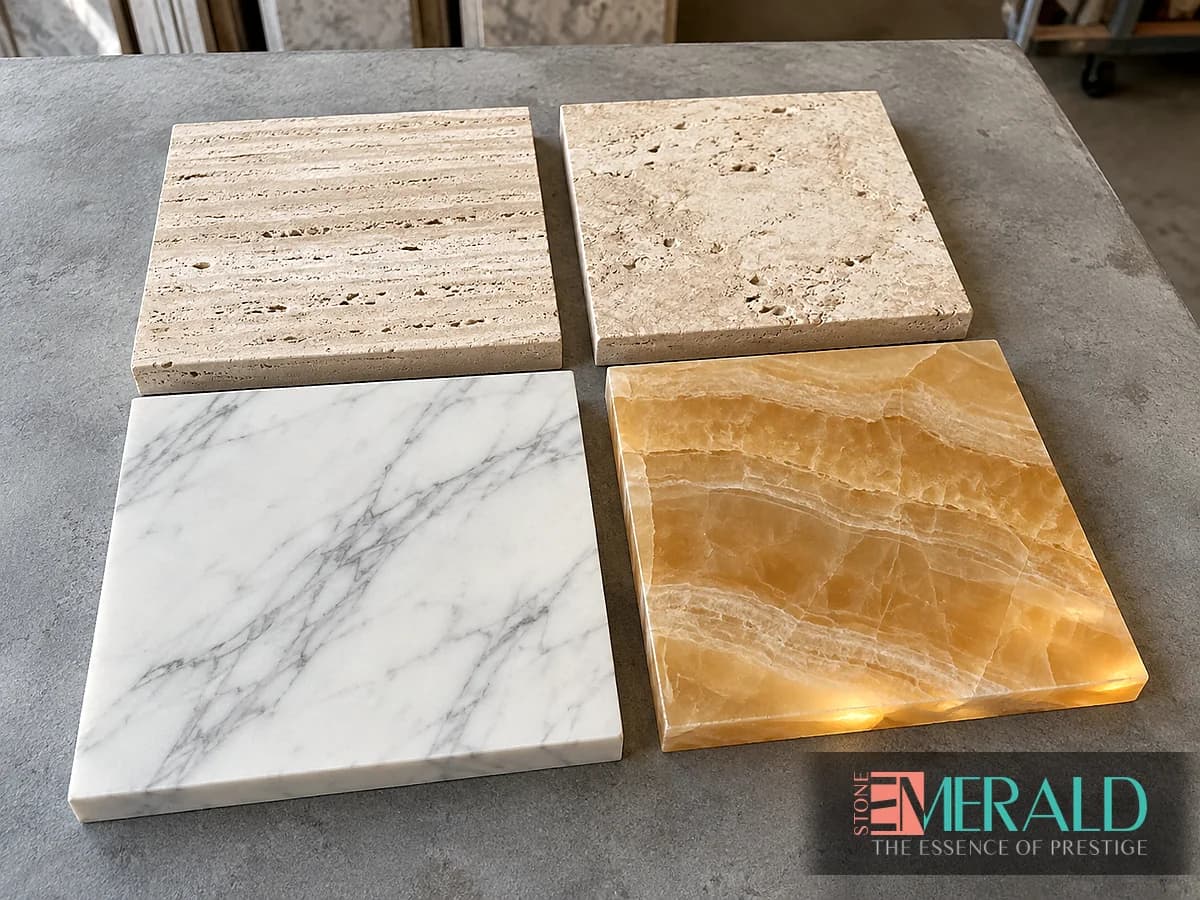
Travertine supply at Emerald Stone
Emerald Stone's stone engineering process for travertine covers application analysis, quarry and grade recommendation matched to budget, production-lot sorting control, and logistics planning through to site delivery.
For facade, lobby, and floor projects, our engineering team arranges viewing of actual slabs under natural light to minimize execution errors and on-site color mismatch.
Contact us for pricing, comparison between Hajiabad and Kashmar, or crystal silver selection on modern projects — or explore the specialist guides below for deeper coverage of each topic.
Experience across dozens of facade, lobby, and landscape projects shows that stone project success depends not only on quarry choice but on precise coordination between supply, cutting, logistics, and installation.
Emerald Stone's stone supply team in Iran acts as technical coordinator between client, architect, and stone contractor from the first consultation through final delivery. Contact us for slab viewing, pricing, or facade selection — or use the specialist travertine guides linked on this page.
Whether you are specifying Hajiabad white for a tower envelope, Kashmar cream for a villa facade, or crystal silver for an urban commercial project, Emerald Stone provides the same engineering-led supply process: application review, quarry matching, lot sorting, and execution support.
Free stone engineering consultation is available for every project scale, from single-villa facades to multi-tower residential and commercial developments. Contact our team through the form on this site or request a callback for slab viewing.
| Parameter | Travertine | Marble | Granite |
|---|---|---|---|
| Water absorption | 1–3% | 0.1–0.5% | 0.1–0.3% |
| Compressive strength | Medium | Medium–high | High |
| Weight | Medium | Medium | High |
| Facade suitability | Excellent | Good (with care) | Excellent |
| Heavy-traffic floor | With resin | Yes | Yes |
Related projects
Frequently asked questions
Which travertine is best for building facades?
Hajiabad white and Kashmar cream suit light envelopes; crystal silver fits modern grey schemes. Final choice depends on climate, fixing system, porosity grade, and sorting plan. On large facades, uniform production-lot sorting from a single quarry batch is essential to avoid visible color drift between floors.
Is travertine suitable for flooring?
Yes for low-traffic areas such as residential reception rooms, corridors, and lobbies with honed or resin-treated finishes. For busy commercial corridors, first-grade travertine with professional sealing or granite substitution on main paths is preferred. Cross-cut travertine at 2 cm thickness is a common choice for large hall floors.
Vein-cut vs cross-cut travertine?
Vein-cut shows linear vertical texture — ideal for walls, facades, and lobby features. Cross-cut delivers a more uniform cloud pattern — better for large floors and open interiors. See our dedicated vein-cut vs cross-cut travertine guide for finish and waste considerations.
What drives travertine pricing?
Quarry origin, grade, thickness, cut type, finish, order volume, and logistics are the main price drivers. First-grade Hajiabad white typically sits in the upper market band. See our travertine price cluster or contact Emerald Stone for current ranges tied to your project specs.
Does travertine need resin treatment?
In high-traffic zones, rain-exposed facades, and wet areas, resin treatment and appropriate honing extend service life and reduce stain absorption. Full maintenance protocols are covered in our travertine maintenance guide and through Emerald Stone's free engineering consultation.
What does Emerald Stone provide for travertine projects?
Technical consultation, quarry and grade selection, bulk supply, sorting control, logistics planning, and execution coordination under our stone engineering model. Our team coordinates between client, architect, and contractor from first meeting through final delivery.
Free stone engineering consultation
Emerald Stone's engineering team helps you select the right stone for your project scope, budget, and execution details.
Request free consultation