
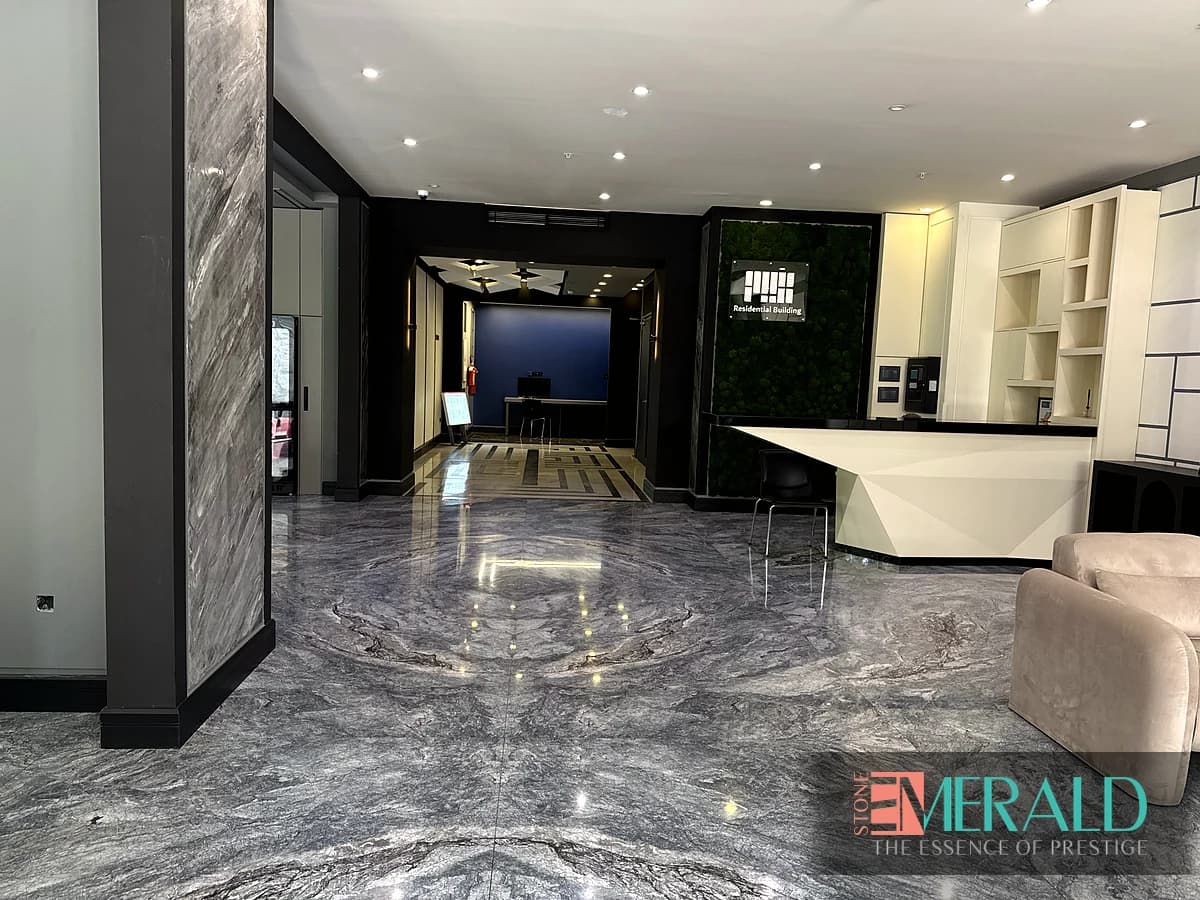
Marmarit, the commercial name for Iran's opaque metamorphosed limestones, is specified mainly for lobby floors, reception areas and interior staircases. Water absorption of roughly 0.5 to 1.5 percent and medium-to-high compressive strength suit interior traffic, while facades are better served by granite. Dehbid, Aligoudarz, Gisou and Black Lady are the leading quarries.
What is marmarit marble and where does it come from?
Marmarit describes a family of metamorphosed limestones that recrystallized under tectonic heat and pressure over millions of years into a fine-to-medium crystalline fabric. In Iran's construction market, marmarit functions more as a commercial trade name for this opaque, polishable stone family than as a strict geological term, which is part of why buyers often confuse it with true marble or onyx when placing an order.
Color ranges from light cream and beige through grey, pale green, and black, and almost no two extracted blocks share exactly the same vein pattern. This variation comes from mineral impurities such as iron oxide, clay, and carbon that entered the rock during metamorphism, producing the decorative veining seen across finished slabs.
Marmarit's popularity in Iranian luxury architecture comes down to its high polishability, color diversity, and ability to be cut into large seamless slabs for flooring. Alongside travertine, it forms one of the two pillars of Iran's building stone industry and appears in the majority of premium interior projects nationwide.
Industrially, marmarit is typically grouped under decorative calcareous stones and is assessed through standardized tests for water absorption, abrasion resistance, and compressive strength rather than visual color inspection alone. Accredited Iranian stone laboratories can issue an independent technical report for each production lot, and these reports form the basis of Emerald Stone's technical consultation.
Marble vs onyx marble: clearing up a common mix-up
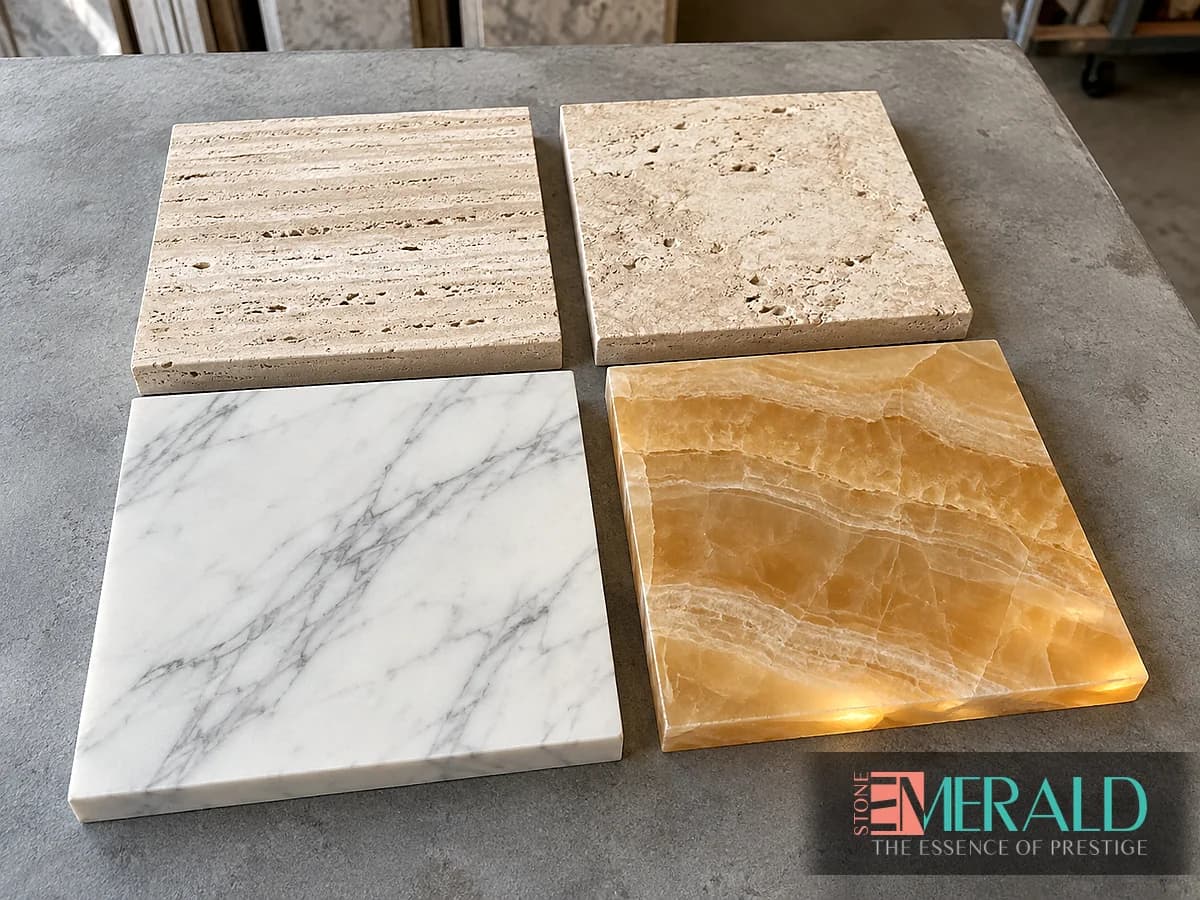
In everyday Persian, the word for 'marble' (marmar) often refers to a veined, semi-translucent stone that the global trade also calls onyx marble, while marmarit is the commercial name for an entirely opaque family of metamorphosed limestones. This overlap in naming is one of the most frequent sources of confusion in Iranian stone purchasing and misleads thousands of buyers every year.
Structurally, true onyx marble and Iran's commercial marmarit both belong to the metamorphosed limestone family, but marmarit typically has finer crystals and a denser fabric, which noticeably improves resistance to wear and impact in high-traffic uses like lobbies and floors, extending the stone's practical service life.
Emerald Stone always recommends clarifying the intended use before ordering: whether translucency for backlighting matters, or uniform color for flooring is the real priority. This simple question lets our technical team recommend marmarit or onyx marble with confidence, and a detailed comparison lives in our marble vs onyx marble cluster.
This naming confusion is not merely academic; it carries a real financial impact, since onyx marble typically costs more than marmarit and requires a different backing layer and installation detailing. A client who orders 'marble for the lobby' without clarifying the intended stone may end up with a different budget or delivery timeline than originally planned, which is exactly why technical consultation before purchase matters so much.
Leading Iranian marble quarries
Dehbid, in Fars province, is one of Iran's oldest and best-known marmarit quarries, producing a light cream stone with soft veining and a relatively uniform texture. Its premium grade, Dehbid Shayan, is especially requested for lobby and reception flooring projects in luxury buildings and typically commands a higher price than the quarry's other grades.
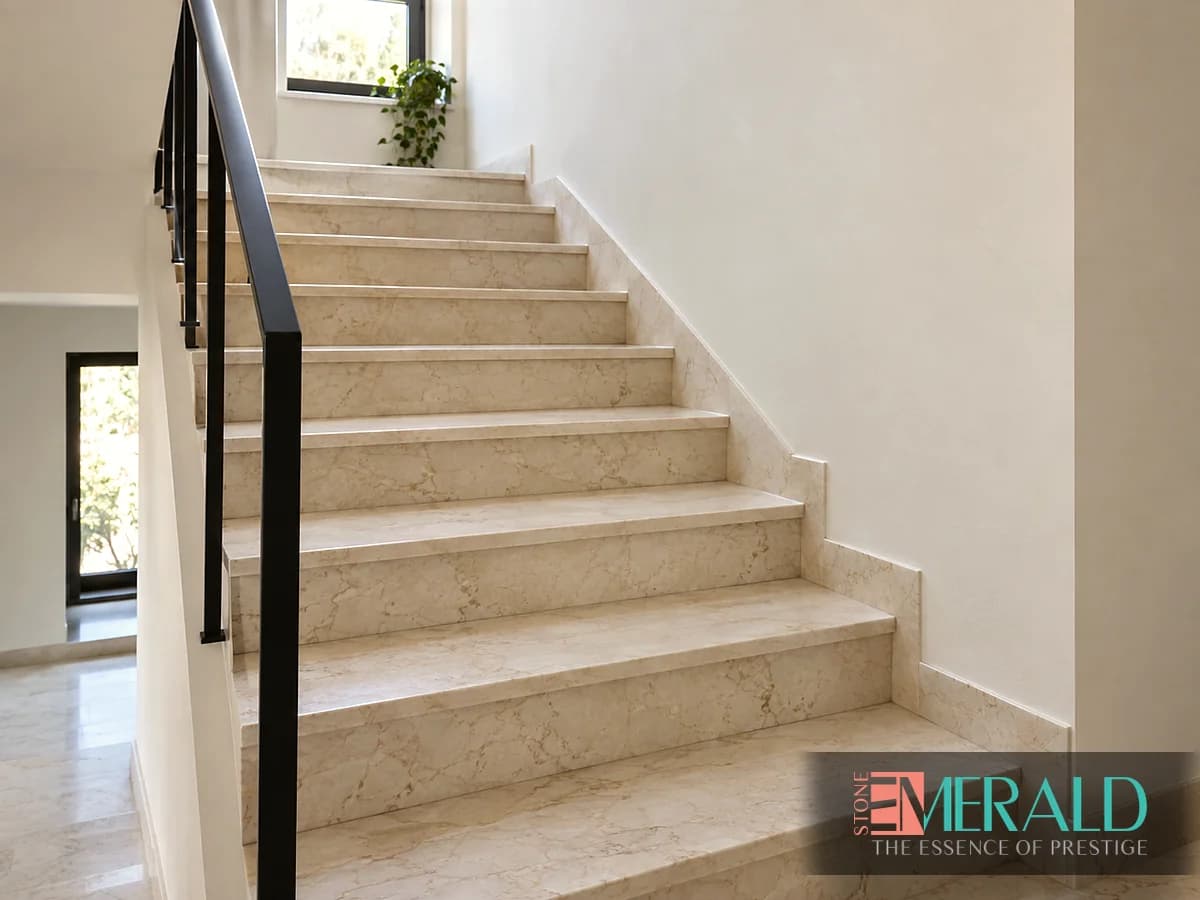
Aligoudarz, in Lorestan province, supplies marble in a grey-to-cream range with relatively uniform texture, and its high extraction volume keeps the final product's pricing competitive. Solid strength and reasonable cost make it a popular choice for large hall floors, staircases, and high-volume projects.
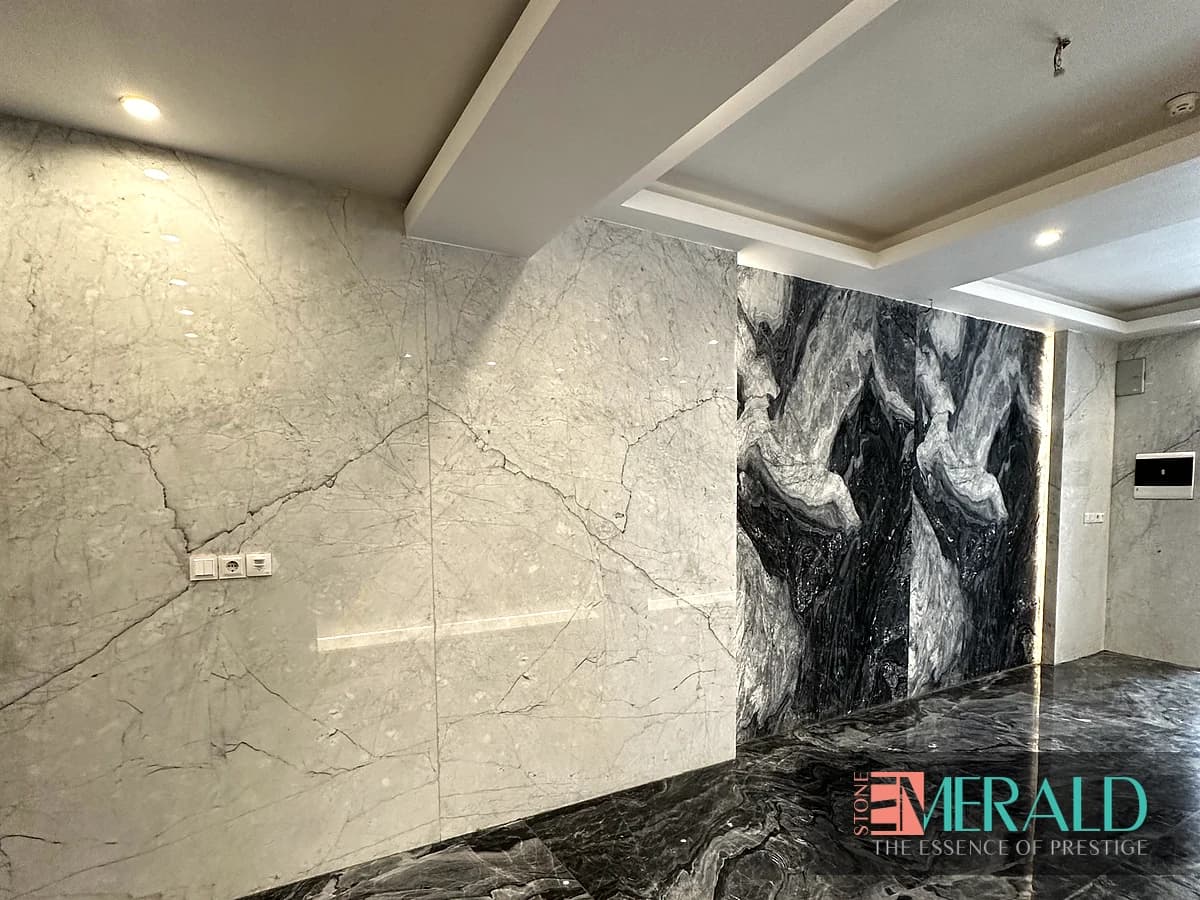
Gisou marble, known for its fine wavy veining reminiscent of braided hair, sits alongside quarries in Khoy and Abadeh as further evidence of Iran's marble diversity, and appeals to designers seeking a pattern distinct from Dehbid's or Aligoudarz's straighter veining. Black Lady, a black marble with gold or white veining, is a distinctive luxury choice for feature walls and signature projects.
Each of these quarries has its own vein pattern and color-consistency profile shaped by local geology, so no single quarry can be labeled the absolute 'best' — selection should instead follow project application, available budget, and interior design style. Emerald Stone recommends a quarry combination matched to these three factors for every project, and can arrange simultaneous sample viewing across quarries when needed. New extraction faces occasionally open within an existing quarry too, so returning clients should always confirm whether current output still matches a sample seen in a previous project.
Quality grading and classification
Marble grading considers several objective factors: color uniformity across the slab face, density of natural micro-fissures, water absorption, and final polish quality. First grade typically shows the fewest surface cracks and the most consistent color compared with second and third grades, which is why it is chosen for a project's most visible surfaces.
During factory sorting, extracted blocks are inspected before slab cutting, and pieces with voids, weak veining, or deep cracks are removed from the main production line. This process directly affects both the stone's durability on-site and its final sale price, and determines the overall quality of the factory's output.
A professional buyer should always view an actual sample from the intended production lot rather than relying on generic catalog imagery, since color and vein pattern can vary noticeably between blocks even within the same quarry, and no accurate judgment is possible without a direct viewing.
Second- and third-grade marmarit are by no means low-quality stone; these grades are typically chosen for substrates, lower-visibility spaces, or tighter budgets and still deliver the strength needed for interior applications. The main difference lies in visual uniformity and price rather than the stone's underlying strength, which opens the door to smart cost savings on less prominent parts of a project.
Common applications for marble stone
Lobbies in office, commercial, and residential buildings are marble's most important application, where a polished finish and consistent color combine with proper lighting to create a lasting sense of luxury and shape a visitor's first impression of the building's overall quality.
Reception floors, front desks, feature walls, and interior staircases are other frequent uses of marmarit. Black marble such as Black Lady is typically chosen for signature walls, hotel lobbies, or luxury retail counters, since its strong color contrast immediately draws a visitor's attention.
For exteriors and facades, marble is less recommended than granite due to comparatively higher water absorption, and should only be used with resin treatment and proper sealing in low-rainfall, temperate climates where freeze-thaw damage risk stays low. Architects who still prefer marble's warmer tone for an entrance canopy or covered porch typically restrict its use to protected areas away from direct rain exposure.
Beyond these traditional uses, marble is increasingly specified for fixed furniture such as kitchen counters, coffee table tops, and television feature panels, especially in luxury residential units where matching floor and furniture materials matters. These applications often use leftover flooring slabs at lower cost while preserving the project's visual continuity. In office buildings and bank branches, light marble is also commonly chosen for teller counters and backdrop walls to convey trust and stability, while luxury retail stores use the same stone with focused lighting to make displayed products stand out; this range of uses shows why marble has grown into part of the broader vocabulary of luxury Iranian interior design.
Technical specs versus onyx marble and granite
Marble's water absorption typically ranges between 0.5 and 1.5 percent, slightly higher than onyx marble but far lower than travertine. Compressive strength sits in the medium-to-high range, and this combination makes marble a dependable choice for high-traffic floors and main building staircases in any climate.
Marble's surface hardness makes it excellent for polished finishes, delivering strong shine after honing, but it is sensitive to common household acids like lemon juice or vinegar, which can dull or etch the surface with prolonged contact, so daily cleaning should always use a mild, neutral detergent only.
The table below offers an approximate comparison of marble against onyx marble and granite across water absorption, compressive strength, translucency, and polish potential, supporting a decision based on real project application rather than guesswork. Architects should treat these figures as a starting point and always confirm exact values with a lab report from the specific production lot being purchased.
Beyond the parameters in the table, marble's unit weight is another factor that must be accounted for in structural design and fixing system selection. For tall walls or cladded suspended ceilings, dead-load calculation and adhesive or anchor selection should be confirmed by a structural engineer, since skipping this step can eventually cause sagging or cracking at connection points. Marble's unit weight typically falls around 2,600 to 2,700 kg per cubic meter, lighter than granite but somewhat heavier than travertine at comparable thickness, so the fixing system for ventilated facades or tall interior walls must be engineered precisely around this weight and the exact slab dimensions being installed.
Engineering criteria for marble selection
Final use case, daily foot traffic, ambient lighting intensity, and overall interior design style are the most important criteria for choosing quarry and grade, and should be defined precisely before placing a final order to avoid a costly mismatch between the stone and its intended application.
For high-traffic spaces like commercial lobbies or airports, first-grade material with a polished finish and minimum 2 cm thickness is recommended so the stone withstands daily wear, scratching, and impact without requiring premature replacement within just a few years of installation.
Matching slab color across a project, especially for seamless flooring, requires ordering from a single production lot; otherwise, color variation between pieces becomes clearly visible under natural daylight and undermines the project's overall execution quality. Reserving a small buffer of extra slabs from the same lot also protects against future repairs after accidental damage during other construction work.
Budget also plays a decisive role: Aligoudarz typically offers more competitive pricing than Dehbid Shayan or Black Lady, without sacrificing the strength needed for floors and staircases. On larger projects, combining several quarries for different zones is a common way to manage total budget without compromising visual quality where it matters most. Recording exact technical specifications in the purchase contract, including quarry name, grade, thickness, and production-lot number, gives the client a clear reference point if delivered stone ever differs from the approved sample, and involving the stone supplier during early architectural planning rather than only at the tender stage generally produces a noticeably better outcome overall across cost, timeline, and final visual result.
Marble supply at Emerald Stone
At Emerald Stone, our stone engineering process for marble covers precise use-case analysis, quarry and grade recommendation matched to budget, production-lot sorting control, and logistics planning through to the job site. This process begins at the first consultation meeting and continues through final handover on installation day.
For lobby, staircase, and seamless flooring projects, our engineering team offers real slab viewing and consultation on coordinating color with other interior materials such as metal, glass, and wood, minimizing installation errors and on-site color mismatches that can be costly to fix later.
For pricing, comparing Dehbid and Aligoudarz, or selecting Black Lady for a specific project, contact Emerald Stone's engineering team or explore the specialized guides below for a deeper look at each quarry. Our consultants can also arrange a joint site visit with your architect to review samples side by side under the project's actual lighting conditions.
Our experience across dozens of lobby, reception flooring, and luxury staircase projects across Iran shows that a stone project's success depends not only on quarry selection but on precise coordination between supply, cutting, freight, and installation, which is why our team acts as the technical coordinator between the client, architect, and installation contractor from the first consultation through final handover. Whether your project needs Dehbid's warm classic tone, Aligoudarz's economical strength, or Black Lady's rare statement look, our engineering-first approach keeps every decision grounded in verified technical data rather than guesswork alone.
| Parameter | Marble | Onyx marble | Granite |
|---|---|---|---|
| Water absorption | 0.5–1.5% | 0.2–0.4% | 0.1–0.3% |
| Compressive strength | Medium–high | Low–medium | High |
| Translucency | Opaque | Semi-translucent | Opaque |
| Polish potential | Excellent | Excellent | Good |
| Lobby / interior floor fit | Excellent | Very good (with backlighting) | Good |
Related projects
Frequently asked questions
What is the difference between marble and onyx marble?
In the Iranian market, 'marble' (marmar) often refers to a veined, semi-translucent onyx stone, while marmarit is the trade name for an opaque family of metamorphosed limestones. Marmarit has finer crystals, resists wear better, and is the safer choice for high-traffic floors and lobbies, while onyx marble suits backlit walls.
Which marble is best for a lobby?
Dehbid Shayan suits bright, classic lobbies; Aligoudarz fits mid-budget, more contemporary projects; Black Lady works well for luxury lobbies with a signature black feature wall. The right choice depends on ambient lighting, interior design style, and available project budget, and is best confirmed through technical consultation.
What drives marble stone pricing?
Quarry origin, quality grade, slab thickness, finish type, order volume, and freight to the project site are the main cost drivers. Black Lady and Dehbid Shayan generally sit at the top of the price range. See our marble price cluster or request a direct quote from Emerald Stone for current ranges.
Is marble suitable for building facades?
Marble is generally less recommended than travertine or granite for facades due to higher water absorption and vulnerability to rain and freeze-thaw cycles. In temperate, low-rainfall climates with resin treatment and proper sealing, it can work for interior or semi-covered facade elements.
Should I choose Dehbid or Aligoudarz marble?
Dehbid offers a lighter cream tone with a more classic look and typically costs more, while Aligoudarz spans grey to cream with solid strength at a more competitive price. Dehbid suits luxury lobbies, and Aligoudarz suits large-volume projects on a tighter budget; the final choice depends on project style.
How should marble stone be maintained?
Clean with warm water and a neutral detergent, avoid household acids like vinegar and lemon juice entirely, and reseal every two to three years to preserve shine and durability. In high-traffic spaces like lobbies, more frequent cleaning and an annual check of the polished surface are also recommended.
Free stone engineering consultation
Emerald Stone's engineering team helps you select the right stone for your project scope, budget, and execution details.
Request free consultation