
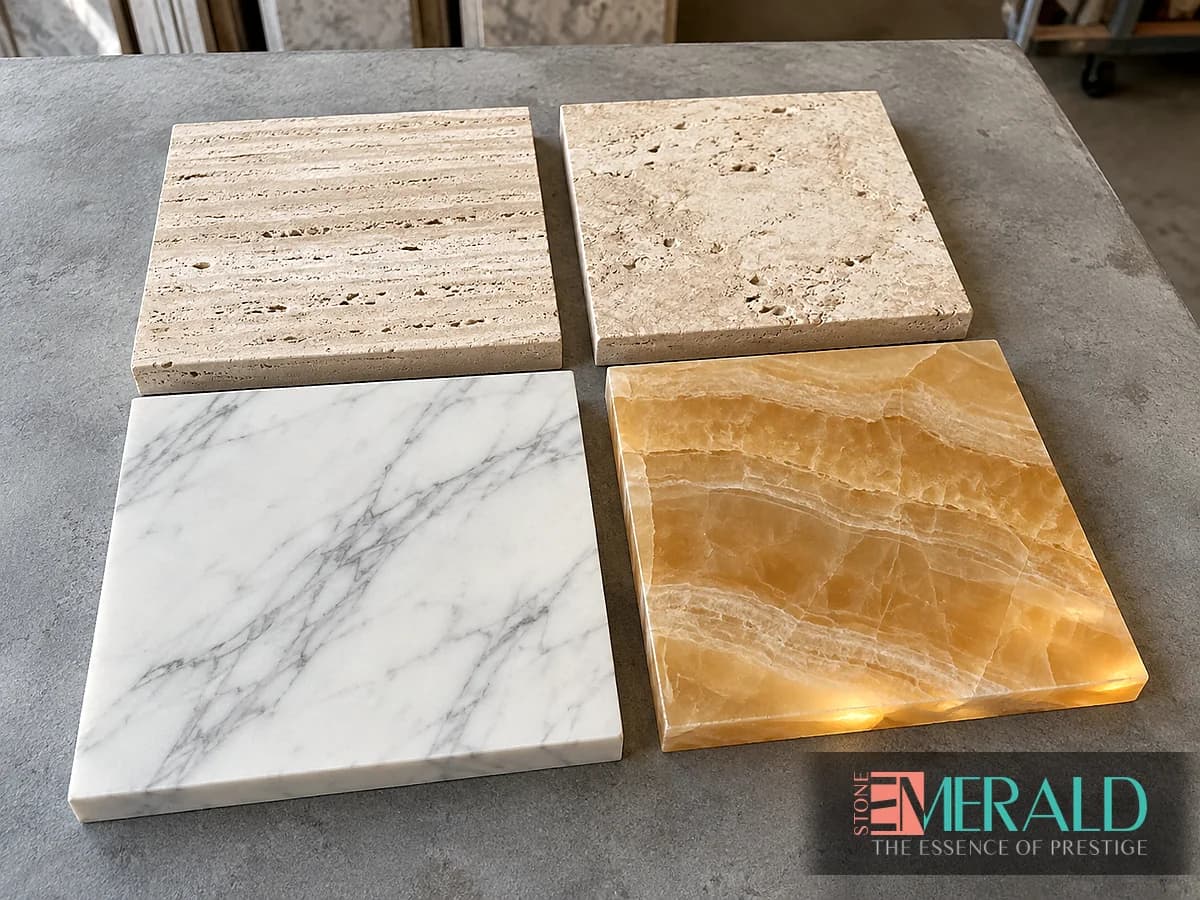
The difference between marble and marmarit is one of category: in Iran, marble usually means semi-translucent onyx, while marmarit is the trade name for fully opaque metamorphosed limestone from quarries like Dehbid and Aligoudarz. Onyx suits backlit surfaces but is brittle and needs a backing layer; marmarit resists wear better on floors and stairs.
Related guide: Complete marble stone guide
Defining marble and onyx marble precisely
In the Iranian stone market, 'marble' most often refers to a veined, semi-translucent stone classified internationally as onyx, prized for its partial translucency, which suits backlighting applications, sometimes simply called backlit stone by installers.
'Marmarit,' by contrast, is a trade name for a group of fully opaque metamorphosed limestones extracted from quarries like Dehbid, Aligoudarz, and Gisou, primarily used for high-traffic floors and walls throughout a residential or commercial building.
This naming overlap stems from everyday Persian usage, where any polished decorative stone is sometimes casually called 'marble,' even though technically and commercially, marble and marmarit are two entirely distinct products with different applications and pricing that must be properly separated before any order.
Even among some non-specialist sellers, the two terms are mistakenly treated as synonyms, which means many clients only discover the real difference between what they ordered and what they expected once they finally receive a physical sample on-site.
Technical differences: hardness, absorption, and translucency
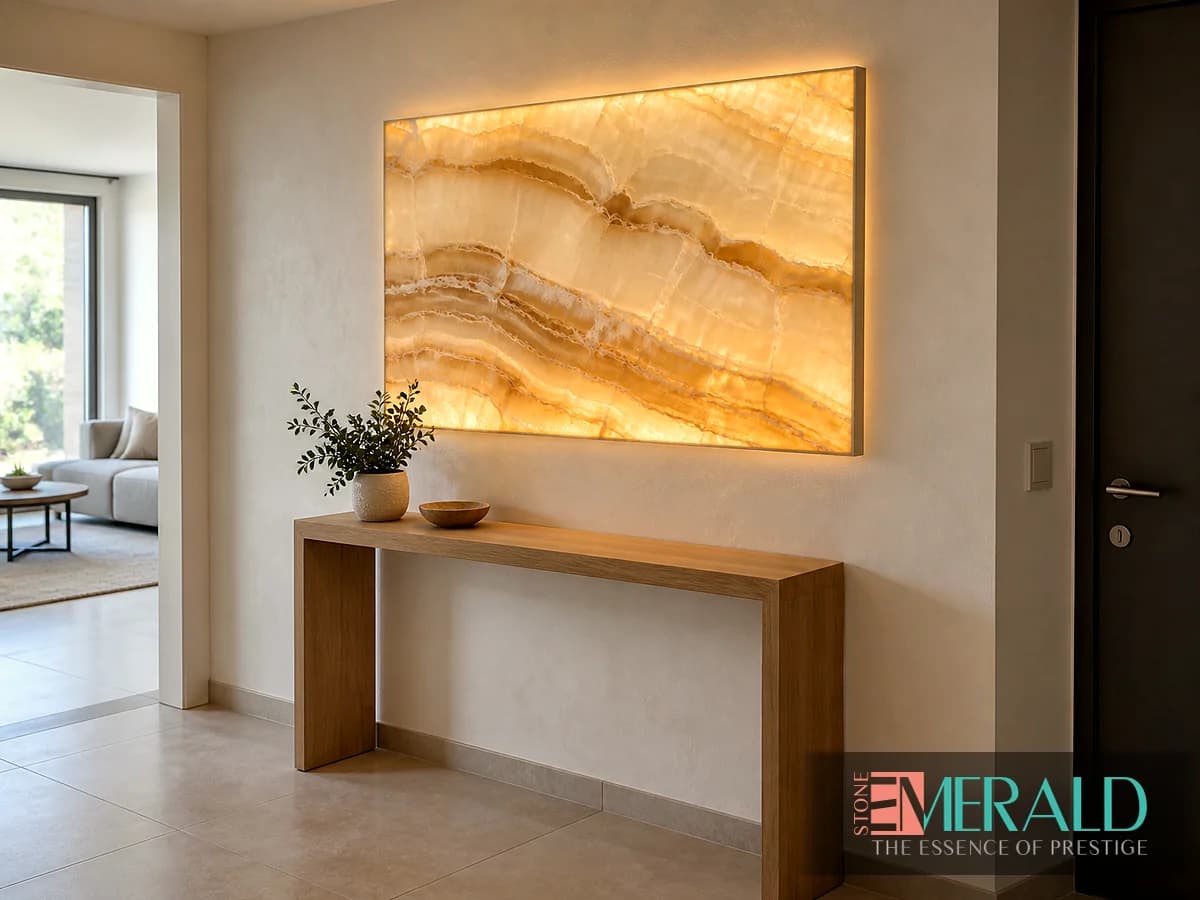
In terms of translucency, onyx marble allows some light to pass through, a quality that sets it apart for backlit counters and feature walls; marmarit is fully opaque and reflects rather than transmits light under any lighting condition whatsoever.
In surface hardness, Iranian marmarit's finer crystal structure generally makes it more resistant to everyday wear and impact than onyx marble, making it the safer, more durable choice for high-traffic floors and busy interior staircases alike.
Water absorption is relatively low for both stones, though onyx marble's more crystalline structure typically gives it a slightly lower figure overall. However, onyx is noticeably more prone to cracking under point loads than marmarit.
Installation method also differs meaningfully: because onyx marble is more brittle and typically thinner, it usually requires a backing layer, such as fiberglass mesh or a glass panel, to withstand installation stress, while marmarit is usually installed without any such backing layer at all.
Which stone suits which application
For a backlit wall behind a bar, a spa feature, or special spaces where the main goal is a lit visual effect, onyx marble is the better choice, since its translucency is exactly what creates that unique, glowing effect.
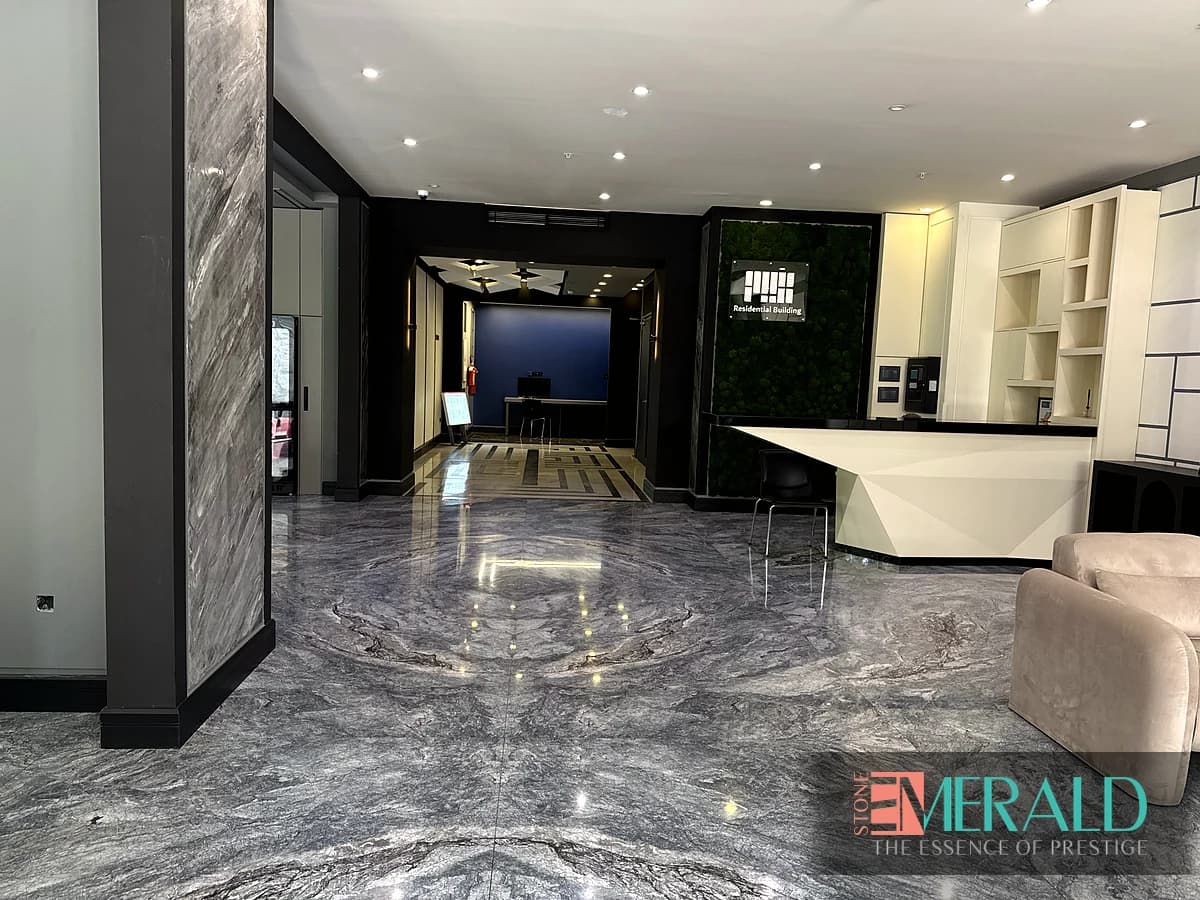
For lobby floors, staircases, and high-traffic walls, marmarit like Dehbid or Aligoudarz is more suitable, offering greater resistance to daily foot traffic without requiring any special backlighting installed behind the stone at all.
In large projects, combining both stones is common: marmarit for broad flooring surfaces, and onyx marble for smaller focal points designed to capture a visitor's attention and set the entire space clearly apart.
For a hotel bar or reception counter, a common approach is to build the main countertop from more durable marmarit and add only a narrow backlit onyx marble strip along the edge or front panel; this controls total cost while still delivering the desired lit visual effect.
A common mistake when ordering stone
Many clients approach a sales team asking for 'marble for the lobby' when what they actually mean is opaque, polished marmarit rather than translucent onyx, which carries entirely different cost and installation requirements.
This mix-up can lead to ordering a stone with a higher cost or different technical needs, such as a backing layer for onyx stability, that was not accounted for in the original project budget and can disrupt the execution schedule.
The best way to avoid this is to describe the intended application and desired look precisely to a technical consultant before ordering, rather than relying solely on the generic term 'marble' or 'marmarit,' which can easily be misinterpreted.
Another common version of this mistake happens when a client brings a photo of a backlit wall found online as a reference without budgeting for genuine onyx marble; in these cases, Emerald Stone typically proposes an alternative using light-colored marmarit with direct lighting to achieve a visually similar effect at a noticeably lower cost. Some clients also confuse a quarry's local name with the onyx trade name, especially when viewing a light cream stone with soft veining; the real difference can be identified quickly and reliably with a simple flashlight test held directly behind a small sample piece.
Emerald Stone's guidance on marble vs onyx marble
In the first conversation with a client, Emerald Stone's consultation team reviews the exact application, budget, and any need for backlighting to determine whether the client actually needs marmarit or onyx marble, without wasting project time. This approach prevents incorrect orders, product returns, and wasted project time, ensuring the final stone precisely matches both the design intent and the client's real available budget.
For guidance choosing between marble and onyx marble for your project, contact Emerald Stone's engineering team or read our complete marble guide for further detailed technical information.
On projects using both stones together, our technical team also oversees color and texture coordination between marmarit and onyx marble so the transition between the two surfaces on a wall or counter looks natural rather than jarring or unplanned to any visitor.
For clients still unsure which stone fits their budget and application, Emerald Stone can also arrange a side-by-side, in-person viewing of marmarit and onyx marble samples under lighting conditions matching the actual project space; this upfront transparency is the main reason architects and developers keep returning to us for this specific consultation, project after project, year after year.
| Criterion | Onyx marble | Marmarit |
|---|---|---|
| Translucency | Semi-translucent | Opaque |
| Suitable for backlighting | Yes | No |
| Wear resistance | Medium | High |
| Common use | Feature walls and backlighting | Floors, lobbies, stairs |
Related products
Frequently asked questions
Is marble the same as marmarit?
No — in the Iranian market, 'marble' usually refers to translucent onyx stone, while marmarit is the trade name for opaque, metamorphosed limestone. The two differ significantly in appearance, hardness, installation method, and application, and should never be confused with one another when placing an order.
Which stone is better for flooring?
Marmarit is the better choice for high-traffic floors because of its greater resistance to daily wear and impact over many years. Onyx marble is better suited to backlit walls or smaller decorative surfaces and is rarely recommended for large floor areas.
Why is onyx marble more expensive than marmarit?
The scarcity of high-quality onyx blocks, the need for a backing layer to stabilize it during installation, and higher processing costs typically make onyx marble pricier than marmarit. Large backlit feature slabs also require tighter sorting and more fabrication waste than standard floor marble.
How can I be sure my order is marmarit and not onyx?
The best approach is to describe your intended application precisely and request a physical sample before finalizing the order. Emerald Stone's consultation team always confirms the exact stone type with the client before issuing a final quote, so naming confusion never leads to the wrong order being placed.
Free stone engineering consultation
Emerald Stone's engineering team helps you select the right stone for your project scope, budget, and execution details.
Request free consultation