
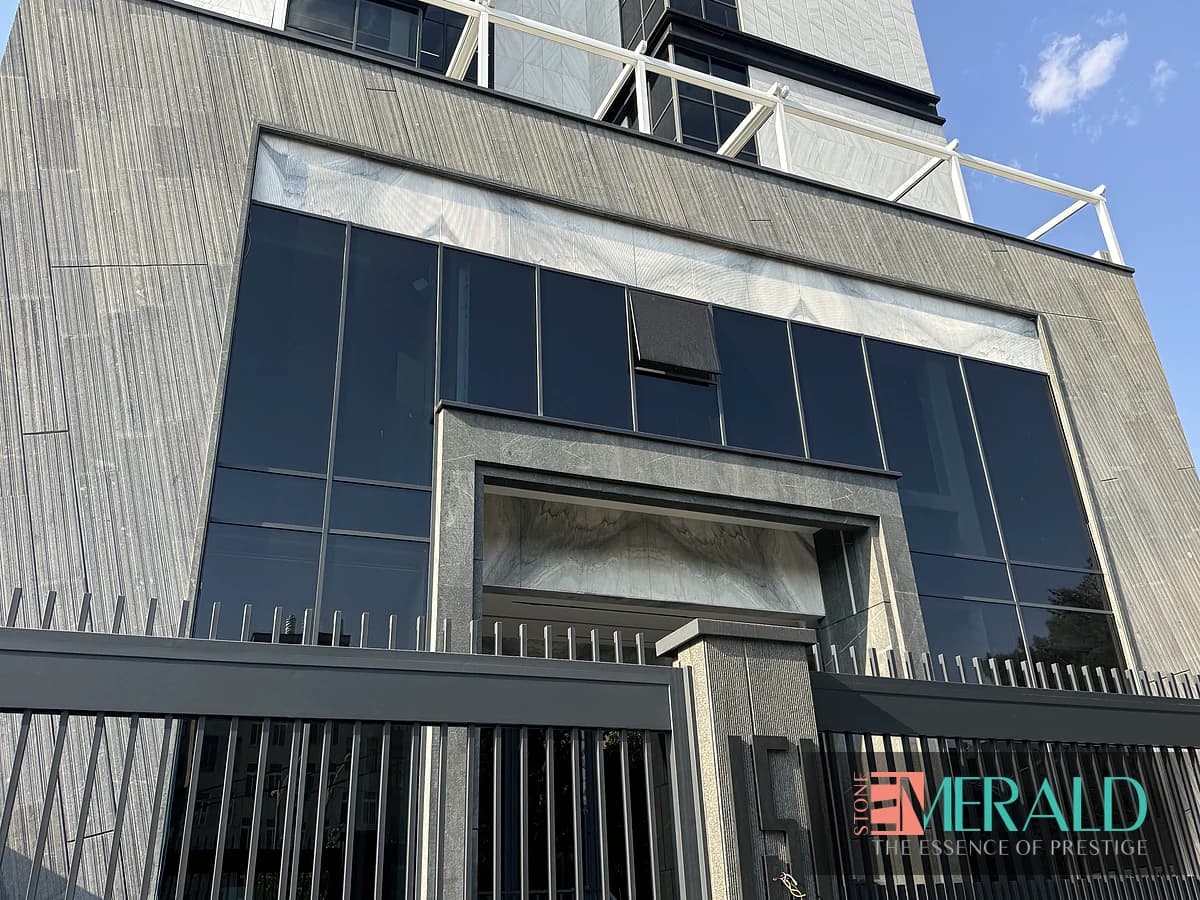
Modern building facades use large-format slabs, typically 60×120 cm or larger, with 3–5 mm joints and concealed anchors. The palette stays neutral: white, light cream, grey and black, with crystal silver travertine, Natanz black granite and light Dehbid marble common. Minimal joints amplify colour variation, so uniform sorting is mandatory.
Related guide: Building facade stone guide
Large format and joint design in modern facades
Modern facades rely on large slabs — typically 60×120 cm and larger — with 3–5 mm joints. The goal is a unified surface minimizing horizontal and vertical lines that fragment the elevation.
Concealed or semi-concealed fixing with standard anchors is common. Plane alignment and thickness variation control are main execution challenges. Precise sorting in stone supply becomes doubly important.
On towers and tall buildings, ventilated rainscreen systems with an air gap are nearly mandatory. Waterproofing and expansion joint details must be finalized in shop drawings before stone order.
Farvardin Tower exemplifies modern natural-stone cladding at urban scale — a project Emerald Stone supplied. Stone facades face daily moisture cycling; lower-absorption stone with matte finish delivers more stable performance against rain, freeze-thaw, and urban pollution. Before final order, review stone samples on site alongside other facade or floor finishes; daylight angle and temperature shift color and texture noticeably, preventing costly specification mistakes.
- Low water absorption on facade stone prevents freeze-thaw damage and joint moisture ingress
- Wind load calculation before thickness selection is mandatory on tall facade envelopes
- Slab viewing in project daylight prevents costly colour mis-specification on site
- Documenting batch technical specs in the supply contract reduces delivery disputes
Combining stone with glass, metal, and timber
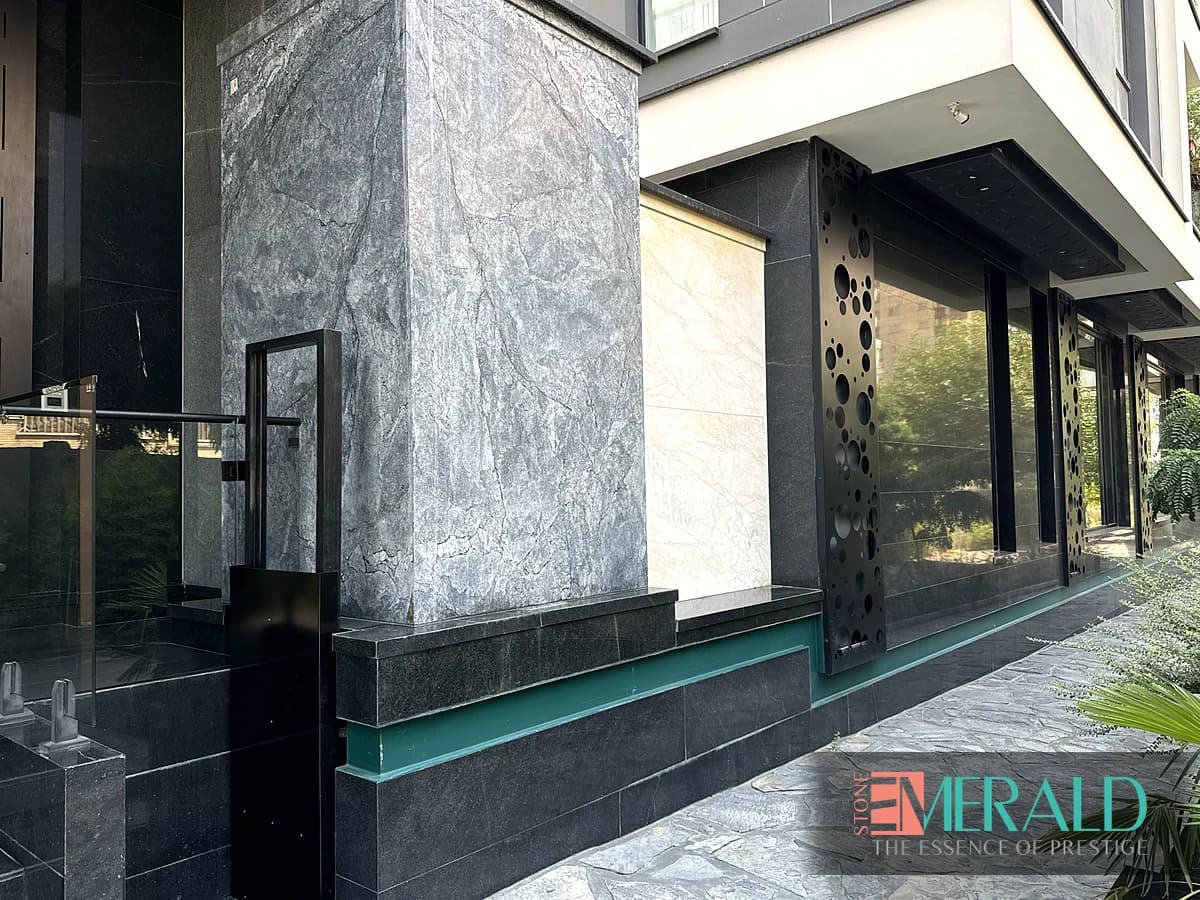
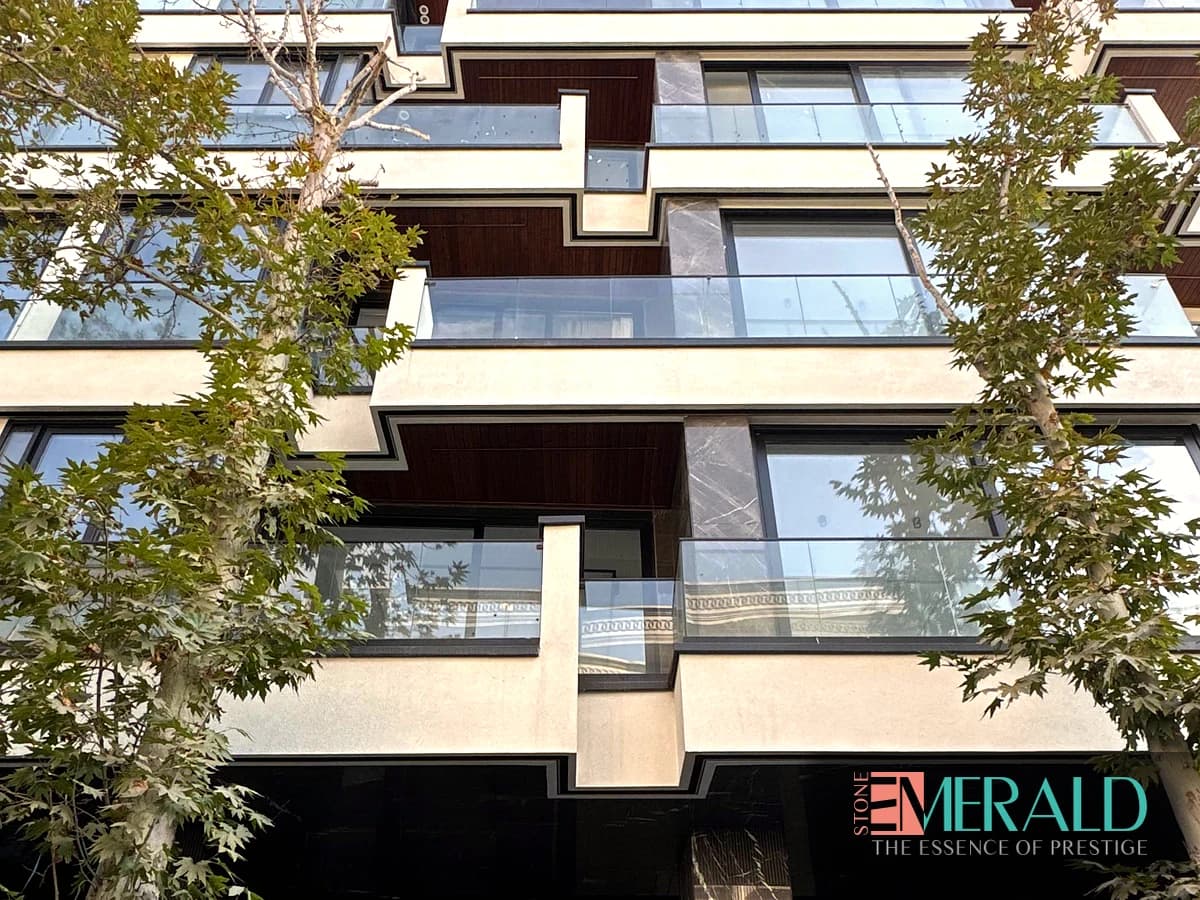
Modern facades often combine stone with structural glazing, aluminium composite panels, and thermowood. This delivers visual variety and budget control simultaneously.
In hybrid design, thickness and fixing systems must align across materials. A 3 cm stone slab against a 4 mm panel demands precise substrate build-up. Coordinating silver stone with brushed metal is a common design move.
Timber in modern facades usually appears as horizontal bands or accent zones. Stone covers durable, permanent building areas; timber sits in periodically replaceable zones.
Our granite and travertine guides help select complementary materials for hybrid facades. Expansion joints, horizontal drip details, and window perimeter sealing are the three zones where most stone facade failures begin — detail them fully on execution drawings. Define numeric tolerances for fissures, pits, tone variation, and batch uniformity in the supply contract so delivery disputes drop and installation schedules stay on track.
- Silver stone with structural glass creates an urban contemporary appearance
- Composite panels in low-traffic zones control facade cost without overall quality loss
- Thermowood is highly popular on modern luxury villa and residential facades
- Material thickness alignment must be defined in facade drawings from design stage
Modern facade stone color palette
Modern facade palettes are typically neutral: white, light cream, grey, and black. Crystal silver travertine is among the most requested options for urban and commercial towers.
Natanz black granite creates contrast and dark horizontal lines on modern facades. Light Dehbid marble suits luxury minimalist projects.
Color uniformity matters more on modern facades because minimal joints and large surfaces amplify any color variation. Professional sorting is mandatory for modern facade supply.
Emerald Stone supplies crystal silver and Kashmar cream travertine with uniform sorting for modern facades. Travertine balances aesthetics, weight, and workability for most Iranian residential and commercial facades; our travertine guide is the complementary reference.
- Expansion joints every 6–8 metres prevent thermal movement cracking on stone facades
- Window perimeter and head sealing are the most common water ingress points on stone cladding
- Honed or sandblasted finishes outperform polished surfaces on exterior facade zones
- Supplier and installer coordination ensures fixing quality and long-term facade durability
Modern facade installation essentials
Slab cutting, handling, and installation precision is critical. Large slabs need crane equipment and experienced crews. Corner breakage in transit is a primary risk.
Anchor systems must carry wind load and stone weight at height. The structural engineer must approve connection design. Our facade installation cluster covers technical detail.
Joint sealing with stone-compatible, UV-resistant materials is essential. On modern facades, joint staining and cracking are more visible than the stone itself.
Stone facades face daily moisture cycling; lower-absorption stone with matte finish delivers more stable performance against rain, freeze-thaw, and urban pollution. Granite is the safer choice in cold and coastal climates due to very low absorption and high hardness; our granite guide covers domestic varieties including Natanz.
- Low water absorption on facade stone prevents freeze-thaw damage and joint moisture ingress
- Wind load calculation before thickness selection is mandatory on tall facade envelopes
- Slab viewing in project daylight prevents costly colour mis-specification on site
- Documenting batch technical specs in the supply contract reduces delivery disputes
Emerald Stone approach to modern facades
On modern facade projects such as Farvardin Tower, Emerald Stone supplies large slabs with precise sorting and execution coordination. Crystal silver is a top product in this category.
Free technical consultation, slab viewing, and comparative stone options serve architects and clients on modern facade projects.
Expansion joints, horizontal drip details, and window perimeter sealing are the three zones where most stone facade failures begin — detail them fully on execution drawings.
Travertine balances aesthetics, weight, and workability for most Iranian residential and commercial facades; our travertine guide is the complementary reference.
Granite is the safer choice in cold and coastal climates due to very low absorption and high hardness; our granite guide covers domestic varieties including Natanz.
Before final order, review stone samples on site alongside other facade or floor finishes; daylight angle and temperature shift color and texture noticeably, preventing costly specification mistakes.
- Expansion joints every 6–8 metres prevent thermal movement cracking on stone facades
- Window perimeter and head sealing are the most common water ingress points on stone cladding
- Honed or sandblasted finishes outperform polished surfaces on exterior facade zones
- Supplier and installer coordination ensures fixing quality and long-term facade durability
| Stone | Color | Style | Project type |
|---|---|---|---|
| Stone | Technical value | Application note | Emerald note |
| Stone | Mid range | Residential project | Suitable |
| Stone | Upper range | Commercial project | With supervision |
Related products
Related projects
Frequently asked questions
What is the best stone for modern facades?
Silver travertine, black granite, and light marble dominate urban modern facades. Large-format slabs, minimal joints, and flat planes define the style. Final choice depends on climate, building height, and concealed fixing systems. Crystal silver travertine is a high-demand Emerald Stone product for modern envelopes.
How does a modern facade differ from a classic one?
Modern facades emphasise large slabs, minimal joints, and flat planes with less decorative tooling. Classic facades feature cornices, pilasters, and ornamental cuts. Modern cladding installs faster but concealed fixing and plane alignment matter more. Combining stone with glass and metal is common in modern design.
Can stone be combined with other materials on modern facades?
Yes — hybrid facades pairing stone with glass, metal, timber, or composite panels are standard in modern architecture. This adds visual variety and helps control budget. Coordinating thickness, colour, and fixing methods across materials is a design requirement. Execution drawings must detail each material junction.
Which fixing system suits modern facades?
On tall buildings and modern envelopes, ventilated rainscreens with mechanical anchors and an air gap are standard. Concealed fixing and minimal joints demand high cutting and alignment precision. On low-rise buildings, mortar-bonded large slabs are also viable. System choice must be coordinated with the structural engineer at design stage.
What slab thickness suits modern facades?
Two to three centimetres suits most modern residential and commercial facades. Tall towers with rainscreen systems may require three centimetres or more. Thickness must align with anchor type, wind load, and structural weight limits. Extra thickness without structural planning only raises cost.
Free stone engineering consultation
Emerald Stone's engineering team helps you select the right stone for your project scope, budget, and execution details.
Request free consultation