
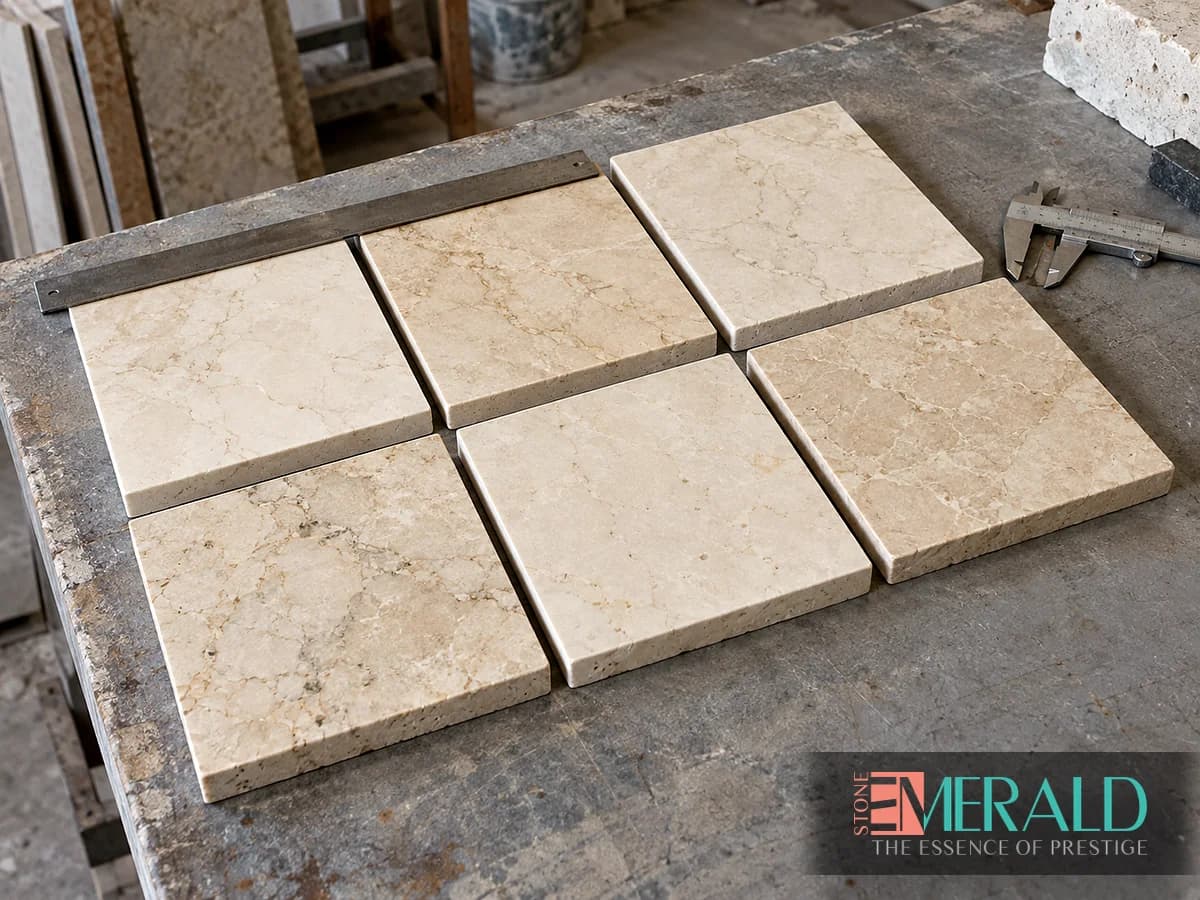
Inspection of natural stone happens at five points: the quarry face, the extracted block, the finished slab, the pre-loading check and unloading at destination. What makes it enforceable is an approved physical sample retained by both parties, plus written numeric tolerances for thickness, calibration, colour range and permitted defects.
Related guide: Iranian natural stone guide
Five inspection points
Quality control on stone is not one event at the end. It is five checks at five different moments, each able to catch only certain things, and skipping the early ones makes the late ones expensive.
At the quarry face the question is geological: which part of the deposit is being worked, how bedding and veining run, and whether the current face is the same material as the reference sample. At the block, the question is internal soundness and yield — cracks, clay seams, colour banding, and the cutting direction that will be used.
At the slab, after sawing and finishing, most measurable criteria become checkable for the first time: thickness and calibration, flatness, finish consistency, colour and vein within the agreed range, filling and resin work, and edge condition. This is also the stage at which sorting into project batches actually happens.
The pre-loading check confirms that the sorted, packed material is the material that was approved and that the pack itself will survive the journey. Unloading at destination is the final checkpoint, and its purpose is to record condition on arrival against the pre-loading record while the container and its seal are still evidence.
- Quarry face — is the working face the same material as the reference?
- Block — internal soundness, cutting direction, expected yield
- Slab — thickness, calibration, flatness, finish, colour range, filling, edges
- Pre-loading — sorted material matches the approval and the pack is sound
- Unloading — condition on arrival recorded against the pre-loading record
Writing acceptance criteria
The single biggest improvement most stone specifications can make is to stop relying on grade names. First grade, premium, select and commercial mean different things to different quarries, factories and markets, and a disagreement about a grade name has nothing objective to settle it.
What works instead is a pair: an approved physical sample, and written numeric tolerances. The sample fixes what cannot practically be described in words — colour, vein character, the visual range that will be accepted — and it only works if both parties hold a retained piece from the same approval, sealed and identified, so neither can substitute it later.
The tolerances fix everything measurable: nominal thickness and permitted deviation, calibration tolerance, dimensional and squareness tolerance, flatness, finish description, edge condition, and the maximum size and number of permitted natural features per slab or per square metre. Each of these should be a number with a unit.
Then define the sampling and the consequence. How many pieces are checked, how they are chosen, what proportion of out-of-tolerance material is accepted, and what happens when a batch fails — replace, re-sort, or accept at an adjusted rate — all agreed before production rather than negotiated afterwards.
- Retain a sealed, identified reference sample on both sides
- State every measurable criterion as a number, a unit and a tolerance
- Describe the visual range as a range, not as a single grade word
- Agree the sampling rate and the consequence of a failed batch in advance
Test standards that exist
There is a mature body of published test methods for dimension stone, and good specifications reference them rather than describing tests from scratch. Naming the method matters, because the same property measured by different procedures produces numbers that cannot be compared with each other.
Water absorption and density are covered by ASTM C97 and, in the European system, by EN 13755 for absorption at atmospheric pressure and EN 1936 for density and porosity. These figures say most about exterior behaviour: how much water the stone takes up, and therefore how it responds to freezing, to staining and to salt.
Strength is approached from two directions. ASTM C170 and EN 1926 cover uniaxial compressive strength, while ASTM C99 covers modulus of rupture and EN 12372 covers flexural strength under concentrated load. For cladding the flexural figures matter more than the compressive one, because a facade panel fails in bending at its anchors rather than by being crushed.
Alongside the test methods sit material specifications — the ASTM specifications for marble, travertine and granite dimension stone among them — which set out property ranges and terminology for each material class. A specification naming the property, the method and the acceptance value it requires is one that can actually be verified.
These are standards that exist and can be called up in a contract; they are not a badge anyone holds. A test result only describes the material it was cut from, so a report on one batch does not certify the next. Say in the specification who tests, on which batch, at whose cost, and what happens when a result falls outside the required range.
- ASTM C97 — absorption and bulk specific gravity of dimension stone
- ASTM C170 — compressive strength; EN 1926 — uniaxial compressive strength
- ASTM C99 — modulus of rupture; EN 12372 — flexural strength under concentrated load
- EN 13755 — water absorption at atmospheric pressure; EN 1936 — density and porosity
Features, filling and defects
Natural stone has natural features, and a specification written as though it does not is unworkable. The useful distinction is between features inherent to the material and visible in the approved sample, and defects that arise from processing or handling.
Veins, colour variation, shell and fossil content, and the porosity that gives travertine its character are material properties. What has to be bounded is their extent: how large a single feature may be, how many per slab, and how close to an edge or a fixing point one may sit — because a vein running through an anchor location is a structural question rather than an aesthetic one.
Filling and resin treatment must be stated explicitly rather than assumed. Whether holes are filled, with what, whether the fill is colour-matched, whether mesh backing is applied, and whether the face is resin-treated all change appearance, price and in-service behaviour, and all of them should be visible in the approved sample.
Chips, corner losses, saw marks, uneven polish, thickness steps between adjacent slabs and cracks are processing and handling matters. These belong in the tolerance table with a permitted size and count, and they are exactly what the pre-loading check is best placed to catch.
- Separate inherent material features from processing defects in writing
- Bound the size, count and position of natural features, especially near anchors
- State filling, resin and mesh treatment explicitly and show it in the sample
- Give chips, saw marks and thickness steps a permitted size and count
Photo documentation
Photographs are the cheapest evidence in the whole supply chain and the most commonly taken badly. A useful stone photo record is systematic: consistent lighting, a scale or reference in frame, bundle or slab identification legible, and enough coverage that a specific piece can be found again later.
Colour is the hard part. Slab photography under mixed or artificial light misrepresents the very thing the buyer is trying to approve, and the phone that took the picture has already adjusted its white balance. Consistent daylight, a neutral reference in frame, and photographing the approved sample under the same conditions as the batch are what make comparison possible at all.
Photographs supplement the physical sample rather than replacing it for a first approval. For repeat orders of a material the buyer already knows, photographic approval against the retained sample is reasonable — provided that retained sample is still the reference and the lighting conditions are the agreed ones.
The record set worth keeping is the approved sample as photographed at approval, the sorted batch, each numbered bundle, the loaded container, the seal in place with its number legible, and the same sequence again at unloading. That set turns a later disagreement into a comparison instead of an argument.
- Photograph under consistent daylight with a neutral reference in frame
- Keep bundle and slab identification legible in the frame
- Hold approval, batch, bundle, load and seal images as one linked set
- Repeat the sequence at unloading before any material is moved

Third-party and buyer inspection
Independent inspection earns its cost on a first order with a new supplier, on a programme large enough that one failed batch is expensive, and wherever a letter of credit or a destination requirement calls for an inspection certificate.
Independent inspection is a service that gets commissioned; it is not a property of the material. Recognised inspection companies will attend a factory or a port and report against the criteria you give them, which means the value of the report depends entirely on how well those criteria were written. An inspector cannot enforce a tolerance nobody wrote down.
Set the terms in the contract: the stage and scope of inspection, sampling method and rate, the acceptance criteria to be applied, reporting format and timing, who pays, and what happens if the batch fails. Agree as well whether a pass is a condition of shipment or a record made in parallel with it.
A buyer or a buyer representative attending in person is equally valid and often more informative, because the questions that matter get asked while looking at the batch laid out on the floor. Where travel is impractical, a video walk-through of the laid-out batch is a reasonable middle ground.
- Commission independent inspection for first orders and large programmes
- Give the inspector written numeric criteria — they cannot invent them
- Agree stage, sampling rate, cost and the consequence of a fail in the contract
- Consider attending in person or by video while the batch is laid out
Resolving a claim from records
A claim is resolved by comparing records, which means the outcome is largely determined before the claim is ever made. Where an approved sample, a tolerance table, a pre-loading photo set and a sealed container all exist, most disagreements collapse into a factual question with a checkable answer.
The sequence is straightforward: notify within the period the contract allows, before material is installed and while the packing is still intact; identify the affected pieces by their bundle and slab marks; photograph them under the same conditions as the approval images; and state the criterion that has not been met, quoting the tolerance rather than an impression.
Where the two sides read the material differently, the tie-breaker is the retained sample plus a measurement — and where a physical property is in dispute, a test to the named method on material from the batch in question. This is precisely why criteria should name the method: it converts a disagreement into a test.
Remedies belong in the contract in advance — re-sorting, replacement of affected pieces on the next shipment, a credit, or acceptance at an adjusted rate — because arguing about what a fair remedy would be is far harder than arguing about whether a tolerance was met. Emerald Stone works this way deliberately: the approval, the tolerances and the record set are agreed before production begins.
- Notify within the contract period, before installation and before repacking
- Identify affected pieces by bundle and slab mark
- Quote the tolerance that was missed rather than a general impression
- Fall back to the retained sample and a test to the named method
How this fits with grading and shipping
Quality control overlaps two neighbouring topics, and the boundary is worth stating. Grading is about how stone is classified and what a classification does and does not tell you; this page is about the inspection and acceptance mechanism that makes any classification enforceable.
Export shipping covers the physical movement — packing, container loading, documents, Incoterms rules and tariff headings — and shares only the pre-loading checkpoint with this page. The export process guide covers the procurement sequence: enquiry, specification, quotation, sample approval and production order.
In practice the three read best in order: agree how the material is classified and specified, agree how it is inspected and accepted, then agree how it is packed, documented and shipped.
| Property | ASTM method | European method | Why it gets specified |
|---|---|---|---|
| Water absorption | ASTM C97 | EN 13755 | Predicts staining, freeze behaviour and sealing need |
| Density and porosity | ASTM C97 | EN 1936 | Feeds dead-load calculation and durability assessment |
| Compressive strength | ASTM C170 | EN 1926 | Relevant to bearing and thick-section work |
| Modulus of rupture and flexural strength | ASTM C99 | EN 12372 | Governs cladding panels and anchor design |
Frequently asked questions
What should a specification say instead of first grade?
Name an approved physical sample retained by both parties, then give numbers: nominal thickness and permitted deviation, calibration tolerance, dimensional and squareness tolerance, flatness, finish, edge condition, and the maximum size and count of permitted natural features. Add the sampling rate and the consequence of a failed batch. Grade words are not comparable between quarries and cannot settle a dispute.
Which tests should I ask for?
Ask for the properties your application actually depends on, each with its method named. Exterior cladding usually needs absorption and flexural strength; heavy paving needs strength and abrasion resistance; interior work often needs less. Absorption and density are covered by ASTM C97, EN 13755 and EN 1936, and strength by ASTM C170, ASTM C99, EN 1926 and EN 12372.
Does a test report cover future shipments?
No. A report describes the material it was cut from, so it is evidence about that batch and not a certificate for the next one. If you need a figure per batch, say so in the specification and set out who tests, on which batch, at whose cost, and what happens if a result falls outside the range you require.
Can slab photos replace a physical sample?
For a first order, no — colour and finish need a physical piece, and both sides need a retained reference to compare against later. For repeat orders of a material already approved, photographic approval against that retained sample is reasonable, provided the lighting conditions are the agreed ones and the sample is still the reference.
When is third-party inspection worth the cost?
On a first order with a new supplier, on a programme large enough that one failed batch is expensive, and whenever a letter of credit or a destination requirement calls for an inspection certificate. The report is only as good as the criteria you give the inspector, so write the tolerances first and the inspection scope second.
Free stone engineering consultation
Emerald Stone's engineering team helps you select the right stone for your project scope, budget, and execution details.
Request free consultation