
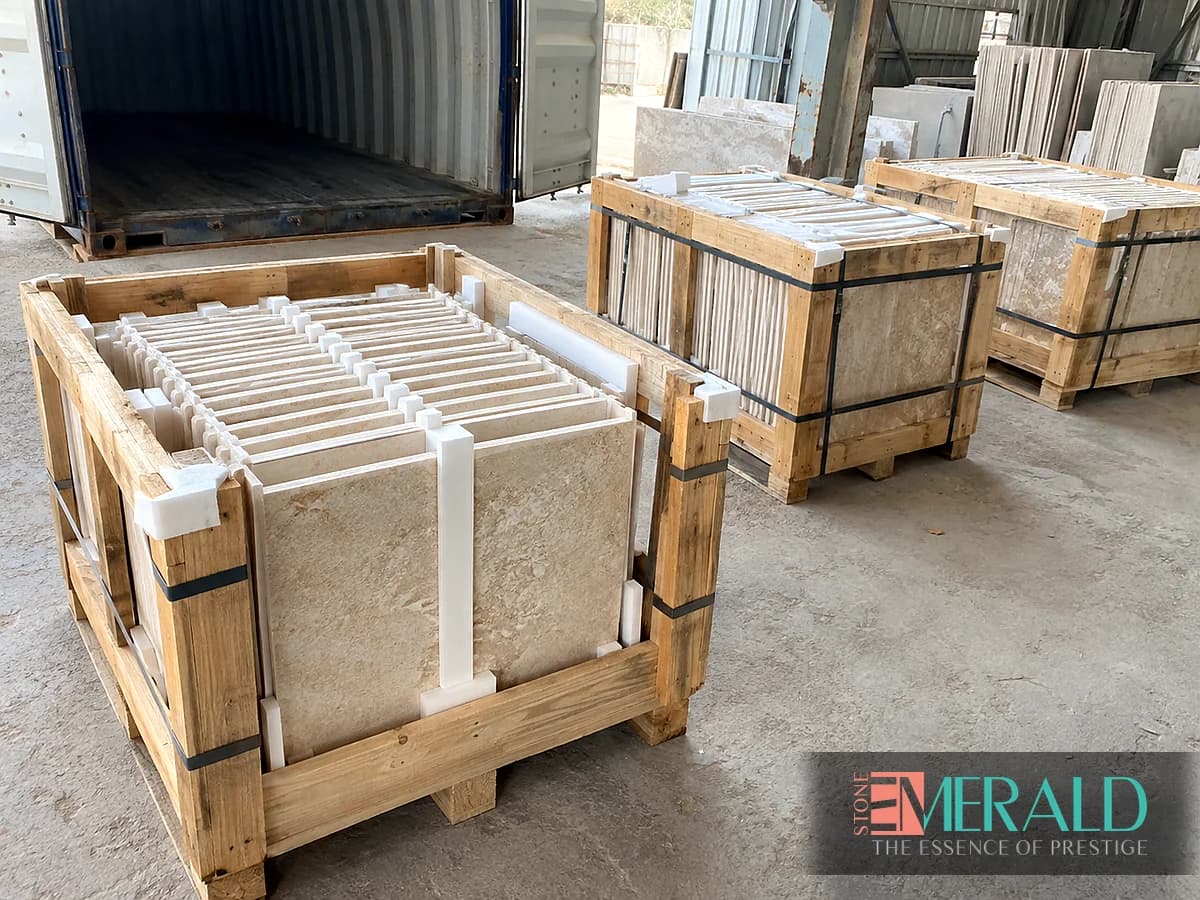
A stone shipment leaves Iran as strapped bundles or timber crates loaded into a 20ft or 40ft container that reaches its payload limit long before it runs out of volume. The paperwork travels alongside: commercial invoice, packing list, certificate of origin and bill of lading, issued against the Incoterm named in the contract.
Related guide: Iranian natural stone guide
Container choice and weight limits
Stone is a dense cargo, so a container reaches its payload rating while there is still empty space above the load. That single fact drives most loading decisions: a stone container is planned by weight, and cubic capacity is the secondary constraint rather than the governing one.
A 20ft general-purpose box is rated for roughly the same maximum gross weight as a 40ft box while offering half the volume, which is why heavy material — blocks, thick slabs, large-format bundles — is normally booked in 20ft units, and lighter finished goods such as thin tiles and crated cut-to-size work go into 40ft units.
The rating on the container door is not the number to plan against on its own. The carrier booking confirmation, road-weight rules at both ends of the journey and any port-specific limit can each cap the load lower, so the loading plan should be agreed against the booked limit rather than the nominal one.
Because weight per square metre depends on thickness and on the density of the specific stone, the square metres that fit into one container are a calculation rather than a constant. Ask for that calculation against your own specification instead of accepting a general figure.
- Plan against the booked payload limit, not the nominal door plate
- Distribute weight along the container floor rather than concentrating it
- Check whether destination road limits are lower than the sea leg allows
- Recalculate square metres per container whenever thickness or stone type changes
Bundles, crates and protection
Slabs travel on edge in timber A-frame or L-shaped bundles, strapped so the pack behaves as one mass; tiles and cut-to-size pieces travel flat in closed crates. Damage in stone shipping is almost always movement — a bundle free to shift or rock will chip its own edges long before the voyage does anything to it.
Edges and corners fail first. Corner protectors, edge battens and enough dunnage to prevent bundle-to-bundle contact cost very little against the value of a chipped slab that can no longer be used at full size.
Moisture matters more than most buyers expect. Material loaded damp can arrive with rust marks from strapping and fixings, with staining wicked in from timber, and with efflorescence on light stone; a container also sweats as it crosses climates. Dry material, dry timber, desiccant packs and a liner where the route justifies one are the practical controls.
Wooden packaging on an international route falls under ISPM 15, the standard requiring treated and marked wood. That marking is a documentation matter as much as a packing one: unmarked timber can be refused at destination even when the stone inside is perfect.
- Strap bundles so the pack cannot rock, then chock it against the container walls
- Protect corners and edges before the bundle is closed, not after
- Load dry, use dry timber, add desiccant on climate-crossing routes
- Confirm every crate and pallet carries an ISPM 15 mark

The export document set
Four documents do most of the work. The commercial invoice states the parties, the goods, the value and the Incoterm with its edition. The packing list breaks the shipment down bundle by bundle with marks, dimensions, and net and gross weights. The certificate of origin, issued by a chamber of commerce, evidences where the stone was quarried and processed. The bill of lading is the contract of carriage and the document against which cargo is released.
The two failure modes are mismatch and vagueness. If packing-list weights do not reconcile with invoice quantities and the bill of lading, customs at destination has a reason to hold the container; if the goods description is too loose to support the tariff classification claimed, the same thing happens. Consistency across the whole set is worth more than elegance in any one document.
Bill of lading terms deserve a decision rather than a default. Consignee named directly versus made out to order, original documents couriered versus telex release, and who is entitled to collect all change what happens when a payment or a courier is delayed.
Further documents are route- and buyer-specific: a wood treatment or fumigation certificate where packaging rules require one, an insurance certificate where the Incoterm places insurance on the seller, a test report where the specification calls for one, and any pre-shipment inspection certificate the destination country mandates. Confirm the full list with your customs broker before production finishes, not after loading.
- Commercial invoice — parties, goods, value, Incoterm and its edition
- Packing list — bundle marks, dimensions, net and gross weights
- Certificate of origin — issued by a chamber of commerce
- Bill of lading — consignee, release method and number of originals decided in advance
Incoterms as they apply to stone
Incoterms allocate cost, risk and formalities; they are not a price and they are not a payment term. Name the rule, the place and the edition together — FOB Bandar Abbas, Incoterms 2020, for example — because a rule quoted without a named place and edition is ambiguous in exactly the situations where it matters.
EXW places the goods at the buyer disposal at the seller premises and leaves export clearance and loading with the buyer, which is awkward on a containerised shipment out of Iran because an overseas buyer can rarely file the export declaration locally. FCA at a named place is usually the better fit where the intention is simply that the buyer controls the main carriage.
FOB is a sea and inland-waterway rule for goods loaded on board at a named port, and Bandar Abbas is the port most often named for Iranian stone. Risk passes when the goods are on board, so the loading sequence, the bill of lading date and the start of the buyer insurance cover should all line up with that moment.
CIF puts carriage and insurance to the named destination port on the seller, but the CIF insurance obligation is a minimum level of cover — Institute Cargo Clauses C under the 2020 edition — not comprehensive cover. A buyer who wants broader protection on high-value stone should either agree a higher level explicitly in the contract or place their own policy over the top.
- Write the rule, the named place and the Incoterms edition as one phrase
- Prefer FCA over EXW when a container and an export declaration are involved
- Under FOB, align the start of your insurance with the on-board moment
- Under CIF, treat the insurance minimum as a floor and check it against cargo value
HS tariff headings
Two tariff-schedule headings cover most stone trade. Heading 2515 is the heading for marble, travertine and other calcareous monumental or building stone in crude or roughly trimmed form, including material merely cut into blocks or slabs of rectangular shape. Heading 6802 is the heading for worked monumental or building stone and articles of it — material dressed, polished, calibrated or otherwise finished beyond simple cutting.
Granite, porphyry, basalt and sandstone in crude or roughly trimmed form sit under heading 2516 rather than 2515, and setts, kerbstones and flagstones have their own heading at 6801. Which heading applies is a question about the state of the material, not about its commercial name.
Headings are only the first four digits. The subheadings beneath them and the duty rate are set by the destination country tariff schedule, so the classification code on your import entry is longer than four digits and is your customs broker call in your own jurisdiction. Have it confirmed before the invoice description is finalised, because the description has to support it.
The practical consequence is that finish level changes the heading and can change the duty. A slab shipped calibrated and polished and the same slab shipped merely sawn are not the same tariff line, which is worth knowing before you decide where the finishing work happens.
- 2515 — marble and travertine, crude or merely cut into blocks or slabs
- 2516 — granite, porphyry, basalt and sandstone, crude or merely cut
- 6801 — setts, kerbstones and flagstones of natural stone
- 6802 — worked monumental or building stone and articles of it
What sets the lead time
A lead time is a chain of dependent steps, and a number quoted without the steps behind it hides where the risk sits. The chain for stone runs: specification frozen, sample or batch approved, quarry block available and extracted, sawing and finishing slot in the factory queue, sorting and packing, export documentation, container booked, vessel sailing.
The steps that actually move are usually the quarry and the vessel. Block availability depends on the working face and, at high-altitude quarries, on the season. Sailing schedules depend on service frequency out of the port and on transhipment at a hub, which is where a long tail on transit time normally comes from.
The steps a buyer controls are the approval steps. Time spent deciding on a sample or reissuing a revised specification is added straight to the front of the chain, and a change after approval can reset production rather than compress it.
Ask for a lead time as a phase-by-phase schedule with the dependency named at each step and a statement of what would move it. A single figure with no structure behind it can neither be checked nor managed.
- Ask for a phased schedule rather than a single number
- Freeze the specification before the schedule is agreed
- Confirm sailing frequency and whether the route transships
- Treat your own approval turnaround as part of the critical path
Checks before the doors close
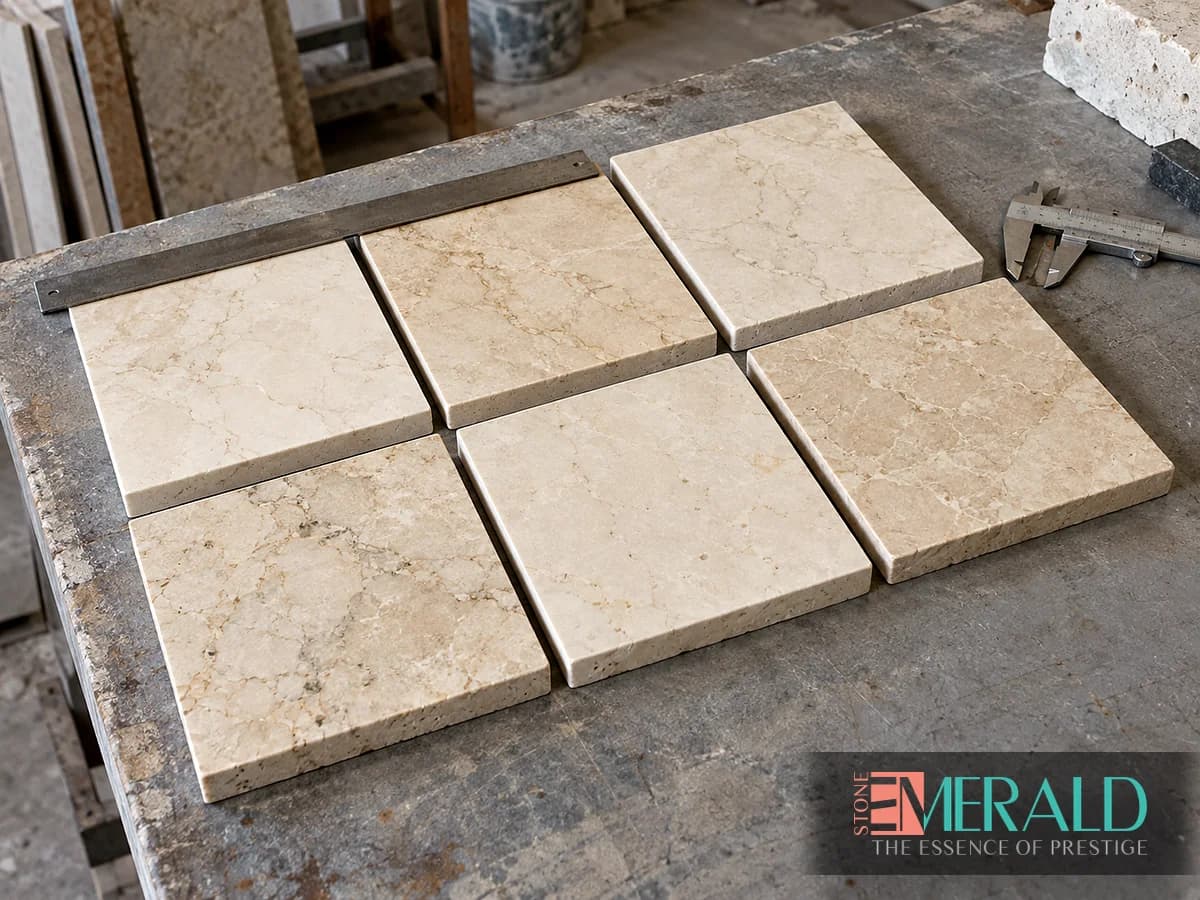
The cheapest place to catch a problem is inside the loading bay. Once the doors are sealed a defect becomes a claim — argued from photographs taken by someone else, at a port you are not standing in, weeks later.
The pre-loading check has two halves. The material check confirms that what is in the bundles matches the approved sample and the written tolerances: colour and vein within range, thickness and calibration inside tolerance, finish consistent, no cracks or open defects beyond what was accepted, filling and resin work as specified. The pack check confirms that bundle marks match the packing list, strapping and corner protection are in place, timber is dry and ISPM 15 marked, and weights reconcile.
Photographs are what make the check useful afterwards. A record showing each bundle marked and identifiable, the load inside the container, the seal number and the seal in place gives both sides a shared factual baseline if anything is questioned at unloading.
Either party can appoint an inspector. Buyers commonly nominate an independent inspection company for a first order or a large programme, and the terms — scope, sampling rate, acceptance criteria, who pays, and what happens on a fail — belong in the contract before production starts rather than in an email after loading.
- Bundle marks reconcile with the packing list and the invoice
- Thickness, finish and colour checked against the approved sample and written tolerances
- Strapping, corner protection and dunnage in place; timber dry and ISPM 15 marked
- Photograph every bundle, the loaded container, and the seal number in place
This page and the export process guide
These two guides deliberately cover different halves of the same job, so that neither has to be read twice. The export process guide is the procurement sequence: how an enquiry becomes a specification, a quotation, an approved sample and a production order, and who does what at each step.
This page begins where the material is finished and ready to move. It is about the physical shipment and the paperwork: how the stone is packed, how the container is loaded and weighed, which documents travel with it, which Incoterms rule and which tariff heading apply, and what is inspected before the doors close.
Read the process guide first if the order is not yet placed, and this page when you are agreeing packing, terms and documents. Send Emerald Stone your destination and specification and the team will map both halves onto your project.
| Item | 20ft general purpose | 40ft general purpose | Effect on a stone load |
|---|---|---|---|
| Nominal internal volume | About 33 cubic metres | About 67 cubic metres | Rarely the limiting factor for stone |
| Nominal payload rating | Roughly 28 tonnes | Roughly 26 tonnes | Almost always the limiting factor |
| Typical use | Blocks and heavy slab bundles | Tiles and crated cut-to-size work | Weight fills a 20ft long before volume does |
| Governing limit in practice | Booked limit from the carrier | Booked limit from the carrier | Road rules at either end can cap it lower |
Frequently asked questions
How many square metres of stone fit in a container?
That is a calculation rather than a fixed figure, because it depends on thickness and on the density of the specific stone. A stone container normally reaches its payload limit while volume is still available, so the answer comes from weight per square metre measured against the booked weight limit. Send your thickness and stone type and it can be worked out on your specification.
Which Incoterms rule should I use for stone from Iran?
It depends on who should control the main carriage and the insurance. FCA at a named place suits a buyer who wants their own forwarder without taking on the export declaration. FOB at a named port fits sea shipments where risk should pass on board. CIF puts carriage and minimum insurance on the seller. Name the rule, the place and the edition in the contract.
Which documents travel with the shipment?
The core set is the commercial invoice, the packing list, the certificate of origin and the bill of lading. Route- and country-specific additions can include a wood treatment or fumigation certificate, an insurance certificate where the Incoterms rule requires one, and a test report or pre-shipment inspection certificate where the specification or the destination demands it. Confirm the full list with your broker before production ends.
Which HS heading applies to my order?
Heading 2515 covers marble and travertine in crude or merely cut form and 2516 covers granite and similar stone, while 6802 covers worked stone that has been polished, calibrated or otherwise finished. The code on your entry has more digits than the heading and is set by your destination tariff schedule, so have your customs broker confirm it before the invoice description is fixed.
How do I protect against damage in transit?
Most transit damage comes from movement and moisture rather than the voyage. Bundles strapped so they cannot rock, corner and edge protection, dry material and dry ISPM 15 marked timber, desiccant on climate-crossing routes, and a photographed pre-loading check with the seal number recorded together remove most of the risk and give you evidence if a claim is still needed.
Free stone engineering consultation
Emerald Stone's engineering team helps you select the right stone for your project scope, budget, and execution details.
Request free consultation