
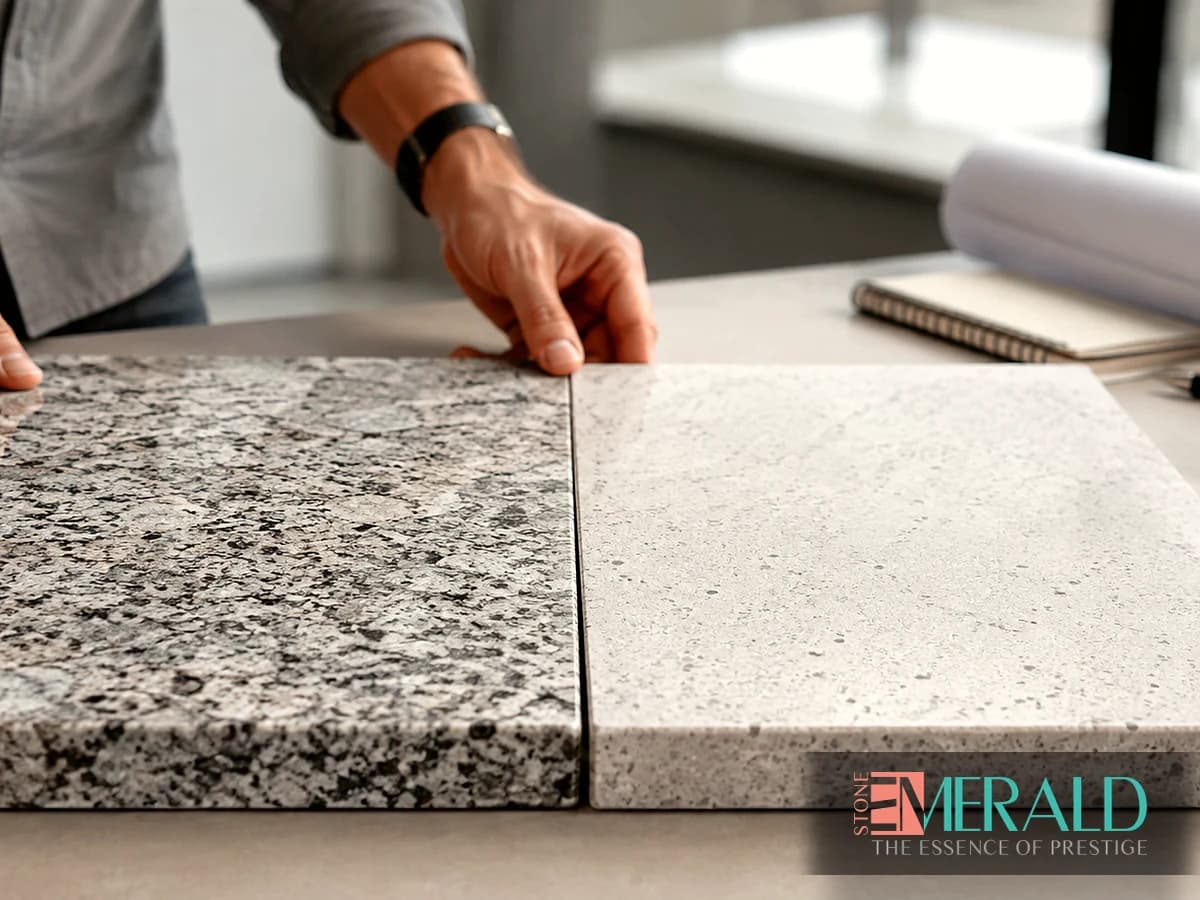
Sealed granite is the safer countertop for kitchens with traditional cooking and frequent hot cookware: quartz binds stone powder with resin, and extreme heat damages that resin. Quartz is less porous and skips annual sealing, but it can discolour in direct sun, so outdoor and semi-open kitchens leave granite as the only durable choice.
Related guide: Stone countertop guide
Heat: granite vs quartz countertops
Heat resistance is the most important difference between granite and quartz kitchen countertops. Granite — a natural igneous stone — handles direct contact with hot pots and pans. Engineered quartz combines stone powder and resin; extreme heat can damage the resin binder.
Placing oven-hot cookware on quartz without a trivet is not recommended; quartz manufacturers typically require heat pads. Sealed granite performs more consistently in this scenario.
In Iranian kitchens with traditional cooking and frequent hot pots, granite is the safer choice. Heat performance should be a priority in the granite or quartz countertop decision.
Heat is not the only criterion, but for long-term counter durability granite's advantage is significant and often decisive in Iranian luxury projects.
- Documenting stone specs in the supply contract prevents delivery disputes on site
- On-site sampling in natural project daylight is recommended before final order
- Supplier and fabricator coordination determines final countertop quality
- Periodic maintenance after handover noticeably extends stone service life
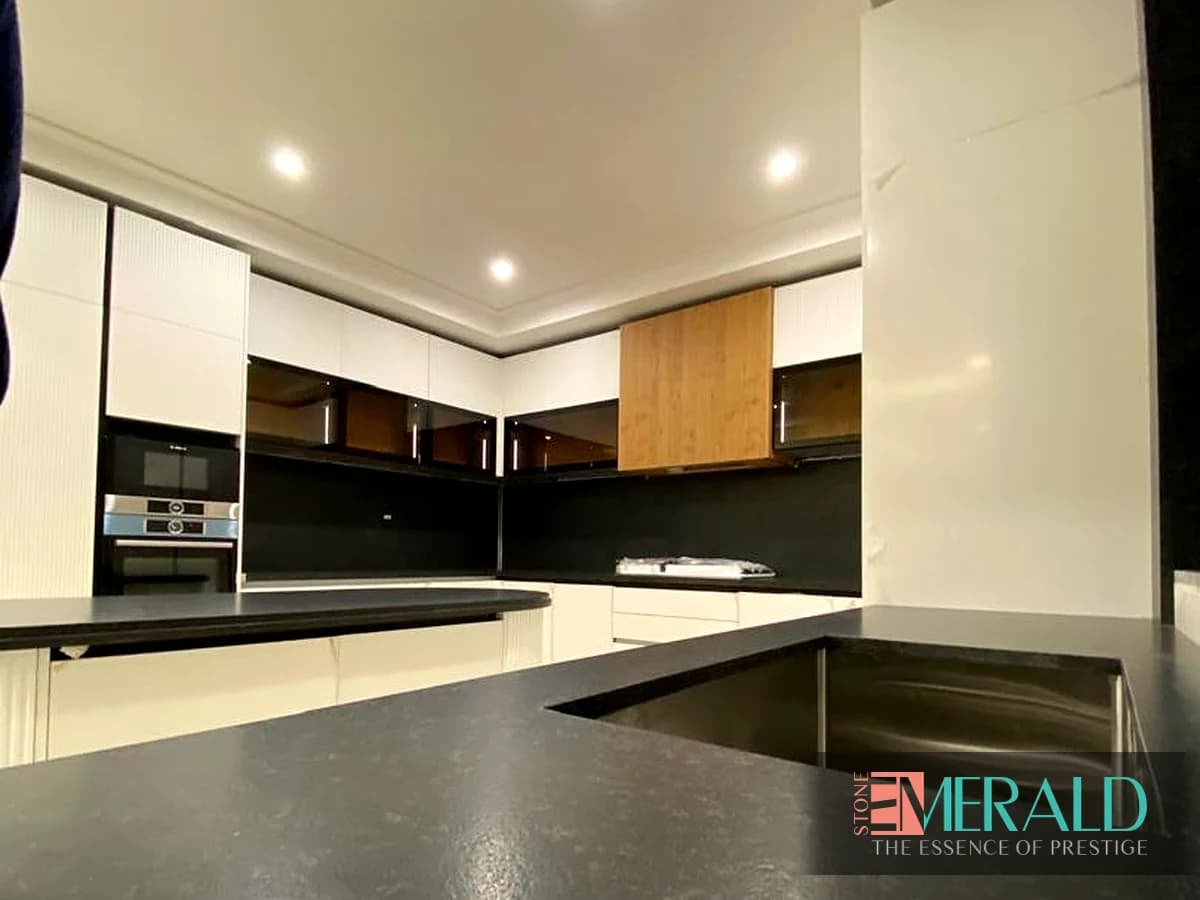
Stains and porosity comparison
Engineered quartz is less porous and generally needs no periodic sealing. Sealed granite performs very well against oil and sauce but requires maintenance cycles.
Marble and travertine are more sensitive than both options for main counters unless strict care is planned. Turmeric, coffee, and oil stains are harder to remove from unsealed stone.
Mild alkaline cleaners suit granite and quartz better than acidic products. Quartz resists household chemicals but abrasive pads dull the surface.
If you want zero annual sealing, quartz wins on maintenance; if you want unique natural appearance and heat resistance, sealed granite wins.
- Documenting stone specs in the supply contract prevents delivery disputes on site
- On-site sampling in natural project daylight is recommended before final order
- Supplier and fabricator coordination determines final countertop quality
- Periodic maintenance after handover noticeably extends stone service life
Appearance: granite vs quartz
Granite vs quartz appearance reflects different philosophies. Every granite slab has unique natural veining and brings living stone into the kitchen. Quartz offers controlled, uniform color from factory production.
Interior designers often pick uniform white quartz for minimal modern kitchens. For Iranian luxury villas, natural granite or marble still dominates.
Granite is recognized as premium natural stone in some resale markets. Quartz has high acceptance in Western markets. Both are accepted in Iran.
Emerald Stone specializes in natural stone and recommends Natanz granite and Dehbid marble for counters; we do not supply quartz.
- Documenting stone specs in the supply contract prevents delivery disputes on site
- On-site sampling in natural project daylight is recommended before final order
- Supplier and fabricator coordination determines final countertop quality
- Periodic maintenance after handover noticeably extends stone service life
Emerald Stone recommendation
For granite or quartz countertops, Emerald Stone recommends natural granite for busy Iranian kitchens. Heat resistance, unique appearance, and compatibility with Iranian project stone are key reasons.
If the designer mandates quartz, a common split is granite at the cooking zone and quartz on a low-traffic island. Our granite guide covers engineered stone comparison.
Contact Emerald Stone for free stone engineering consultation on granite vs other options.
Before final order, review slab samples on site alongside cabinets and flooring; daylight angle shifts counter stone color and texture noticeably, preventing costly specification mistakes.
Coordinating stone supply with the fabricator before final order prevents slab waste, visible center seams, and installation delays.
Regular penetrating sealer and dedicated cutting boards noticeably extend stone countertop service life in busy kitchens.
- Documenting stone specs in the supply contract prevents delivery disputes on site
- On-site sampling in natural project daylight is recommended before final order
- Supplier and fabricator coordination determines final countertop quality
- Periodic maintenance after handover noticeably extends stone service life
Additional engineering detail
Three-centimeter thickness without subtop is recommended for residential counters; economical projects may use two-centimeter slabs with metal subtop.
At Emerald Stone, counter stone selection follows cooking style, household size, and maintenance budget — not catalog color alone.
Documenting batch grade, thickness, and finish in the supply contract prevents delivery disputes and workshop stoppages.
For kitchen islands, jumbo slabs or bookmatched pairs from one batch keep seams out of the primary sight line.
- Documenting stone specs in the supply contract prevents delivery disputes on site
- On-site sampling in natural project daylight is recommended before final order
- Supplier and fabricator coordination determines final countertop quality
- Periodic maintenance after handover noticeably extends stone service life
Additional engineering detail
Counter edge profile affects corner safety and impact resistance and must align with fabricator capability.
Before final order, review slab samples on site alongside cabinets and flooring; daylight angle shifts counter stone color and texture noticeably, preventing costly specification mistakes.
Coordinating stone supply with the fabricator before final order prevents slab waste, visible center seams, and installation delays.
Regular penetrating sealer and dedicated cutting boards noticeably extend stone countertop service life in busy kitchens.
- Documenting stone specs in the supply contract prevents delivery disputes on site
- On-site sampling in natural project daylight is recommended before final order
- Supplier and fabricator coordination determines final countertop quality
- Periodic maintenance after handover noticeably extends stone service life
Additional engineering detail
Three-centimeter thickness without subtop is recommended for residential counters; economical projects may use two-centimeter slabs with metal subtop.
At Emerald Stone, counter stone selection follows cooking style, household size, and maintenance budget — not catalog color alone.
Documenting batch grade, thickness, and finish in the supply contract prevents delivery disputes and workshop stoppages.
For kitchen islands, jumbo slabs or bookmatched pairs from one batch keep seams out of the primary sight line.
- Documenting stone specs in the supply contract prevents delivery disputes on site
- On-site sampling in natural project daylight is recommended before final order
- Supplier and fabricator coordination determines final countertop quality
- Periodic maintenance after handover noticeably extends stone service life
| Criterion | Granite | Quartz |
|---|---|---|
| Natural | Yes | No |
| Heat | Excellent | Moderate |
| Sealing | Annual | Not required |
| Look | Unique | Uniform |
Related products
Frequently asked questions
Granite or quartz for Iranian-style cooking?
In kitchens with traditional cooking and hot pots, sealed granite is the safer choice. Granite's heat resistance significantly outperforms engineered quartz under direct hot cookware contact.
Is quartz better against stains?
Yes — engineered quartz is less porous and generally needs no periodic sealing. Sealed granite performs very well but requires annual maintenance cycles.
Does Emerald Stone supply quartz?
Emerald Stone specializes in natural stone and recommends Natanz granite and Dehbid marble for counters. Split layouts with granite at the cooking zone are common.
Which suits outdoor kitchens?
Natural granite is virtually the only durable choice for outdoor and semi-open kitchens in Iran's climate. Quartz may discolor under direct sunlight.
Free stone engineering consultation
Emerald Stone's engineering team helps you select the right stone for your project scope, budget, and execution details.
Request free consultation